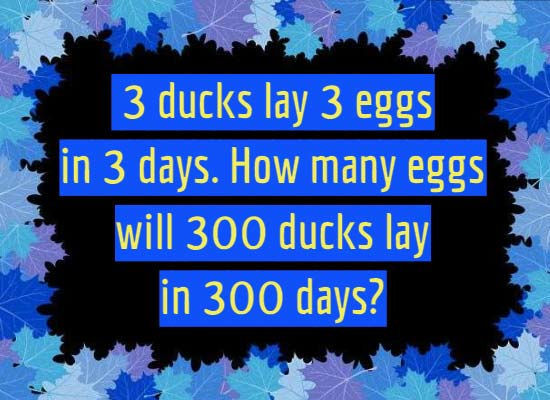
3 ducks lay 3 eggs in 3 days...
[2592] 3 ducks lay 3 eggs in 3 days... - 3 ducks lay 3 eggs in 3 days. How many eggs will 300 ducks lay in 300 days? - #brainteasers #riddles - Correct Answers: 281 - The first user who solved this task is Djordje Timotijevic
BRAIN TEASERS
enter your answer and press button OK

3 ducks lay 3 eggs in 3 days...

3 ducks lay 3 eggs in 3 days. How many eggs will 300 ducks lay in 300 days?
Correct answers: 281
The first user who solved this task is Djordje Timotijevic.
#brainteasers #riddles
Register with your Google Account and start collecting points.
Check your ranking on list.

Blind Man

Husband and wife are waiting at the bus stop with their nine children. A blind man joins them after a few minutes. When the bus arrives, they find it overloaded and only the wife and the nine kids are able to fit onto the bus.
So the husband and the blind man decide to walk. After a while, the husband gets irritated by the ticking of the stick of the blind man as he taps it on the sidewalk, and says to him, "Why don't you put a piece of rubber at the end of your stick? That ticking sound is driving me crazy."
The blind man replies, "If you would've put a rubber at the end of YOUR stick, we'd be riding the bus ... so shut up."  

Jokes of the day - Daily updated jokes. New jokes every day.
Follow Brain Teasers on social networks

Brain Teasers

puzzles, riddles, mathematical problems, mastermind, cinemania...

Rupert Wildt

Died 9 Jan 1976 at age 70 (born 25 Jun 1905).German-American astronomer who studied atmospheres of planets. He identified (1932) certain absorption bands (observed by Slipher) in the spectra of Jupiter and the outer planets as indicative of ammonia and methane as minor components of these planets which are primarily composed of hydrogen and helium. He speculated (1937) that droplets of formaldehyde formed the clouds of Venus, since water was not detected. (In fact, surface water is absent on Venus, but the clouds do contain water with sulphur and sulphuric acid.) In 1939, he realized the importance of the negative hydrogen ion for stellar opacity. By the 1940s, he proposed the greenhouse theory to explain how atmospheric gases produced unexpectedly high temperatures of Venus.
This site uses cookies to store information on your computer. Some are essential to help the site properly. Others give us insight into how the site is used and help us to optimize the user experience. See our privacy policy.