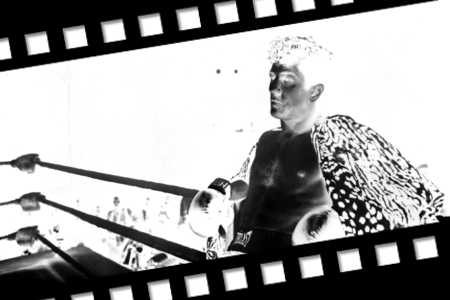

CINEMANIA: Guess the movie title
[3056] CINEMANIA: Guess the movie title - See negative of movie scene and guess the title. Length of words in solution: 6,4 - #brainteasers #movie #film #cinemania - Correct Answers: 35 - The first user who solved this task is Erkain Mahajanian
BRAIN TEASERS
enter your answer and press button OK

CINEMANIA: Guess the movie title

See negative of movie scene and guess the title. Length of words in solution: 6,4
Correct answers: 35
The first user who solved this task is Erkain Mahajanian.
#brainteasers #movie #film #cinemania
Register with your Google Account and start collecting points.
Check your ranking on list.

Long lines everywhere

There was a guy in high school that landed a date with the hottest girl in class for the prom.
First, he went to pick out a suit, and had to wait in a huge line.
Then he went and picked out flowers, and waited in a huge line.
Even when he called around for limo's, he had to wait in hold lines for all of them.
Getting ready for after the prom, there was even a long line at the pharmacy.
Finally the big night arrives and he takes his dance to the prom. When they get there, he asks his date if she wants him to get drink and she says yes.
Much to his surprise, there was no punch line.
Jokes of the day - Daily updated jokes. New jokes every day.
Follow Brain Teasers on social networks

Brain Teasers

puzzles, riddles, mathematical problems, mastermind, cinemania...

Sir Joseph Wilson Swan

Died 27 May 1914 at age 85 (born 31 Oct 1828). English scientist, chemist, physicist and inventor, born in Sunderland, Yorkshire, who produced an early electric incandescent lamp. He began these experiments in the 1840's and obtained a UK patent covering a partial vacuum, carbon filament incandescent lamp in 1860. Swan's early lamps provided low light output, were short lived, and were operated from battery cells. Low voltage operation required relatively high filament current that necessitated that the power source be co-located near the Swan lamp. He also addressed the problem of photographic print fading and in the mid 1850s some began to experiment with a solution using carbon, perfecting and patenting the process in 1864. Thus Swan invented the dry photographic plate, an important improvement in photography.[Image: pencil drawing by M. Agnes Cohen, 1894.]
This site uses cookies to store information on your computer. Some are essential to help the site properly. Others give us insight into how the site is used and help us to optimize the user experience. See our privacy policy.