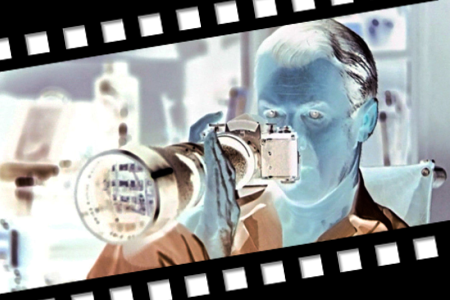
CINEMANIA: Guess the movie title
[3396] CINEMANIA: Guess the movie title - See negative of movie scene and guess the title. Length of words in solution: 4,6 - #brainteasers #movie #film #cinemania - Correct Answers: 26 - The first user who solved this task is Djordje Timotijevic
BRAIN TEASERS
enter your answer and press button OK

CINEMANIA: Guess the movie title

See negative of movie scene and guess the title. Length of words in solution: 4,6
Correct answers: 26
The first user who solved this task is Djordje Timotijevic.
#brainteasers #movie #film #cinemania

Register with your Google Account and start collecting points.
Check your ranking on list.

Wishful thinking

A wife went to the police station with her next-door neighbor to report that her husband was missing. The policeman asked for a description.

She said, "He's 35 years old, 6 foot 4, has dark eyes, dark wavy hair, an athletic build, weighs 185 pounds, is soft-spoken, and is good to the children."

The next-door neighbor protested, "Your husband is 5 foot 4, chubby, bald, has a big mouth, and is mean to your children."

The wife replied, "Yes, but who wants HIM back?"

Jokes of the day - Daily updated jokes. New jokes every day.
Follow Brain Teasers on social networks

Brain Teasers

puzzles, riddles, mathematical problems, mastermind, cinemania...

Sir Edwin Ray Lankester

Born 15 May 1847; died 15 Aug 1929 at age 82. British zoologist whose interests embraced comparative anatomy, protozoology, parasitology, embryology and anthropology. He was one of the first to describe protozoan parasites found in the blood of vertebrates. Lankestrella (a parasite related to the causative agent of malaria) carries his name. His work contributed to an understanding of the disease. Based on his investigation into the comparative anatomy of the embryology of invertebrates, Lankester endorsed Darwin's theory of evolution, In anthrolopology, his activities included the discovery of flint implements, evidence of early man, in Pliocene sediments, Suffolk. He was Director of the British Museum of Natural History (1898-1907).«
This site uses cookies to store information on your computer. Some are essential to help the site properly. Others give us insight into how the site is used and help us to optimize the user experience. See our privacy policy.