CINEMANIA: Guess the movie title
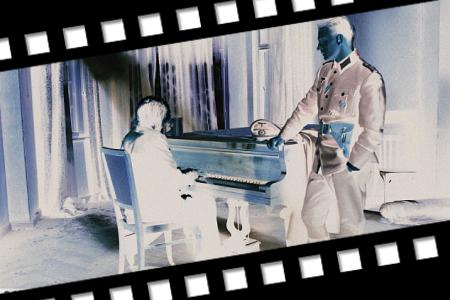
[3513] CINEMANIA: Guess the movie title - See negative of movie scene and guess the title. Length of words in solution: 3,7 - #brainteasers #movie #film #cinemania - Correct Answers: 34 - The first user who solved this task is On On Lunarbasil
BRAIN TEASERS
enter your answer and press button OK

CINEMANIA: Guess the movie title

See negative of movie scene and guess the title. Length of words in solution: 3,7
Correct answers: 34
The first user who solved this task is On On Lunarbasil.
#brainteasers #movie #film #cinemania
Register with your Google Account and start collecting points.
Check your ranking on list.

A guy gets on a plane and find...

A guy gets on a plane and finds himself seated next to a cute blonde.
He immediately turns to her and makes his move.
"You know," he says, "I've heard that flights will go quicker if you strike up a conversation with your fellow passenger.
So let's talk."
The blonde, who had just opened her book, closes it slowly and says to the guy, " What would you like to discuss?"
"Oh, I don't know,"says the guy.
"How about nuclear power?"
"OK," says the blonde.
"That could be an interesting topic.
But let me ask you a question first.
A horse, a cow, and a deer all eat the same stuff--grass.
Yet the deer excretes little pellets, the cow turns out a flat patty, and the horse produces muffins of dried poop. Why do you suppose that is?"
The guy is dumbfounded. Finally he replies, "I haven't the slightest idea."
"So tell me," says the blonde, "How is it that you feel qualified to discuss nuclear power when you don't know shit?
Jokes of the day - Daily updated jokes. New jokes every day.
Follow Brain Teasers on social networks

Brain Teasers

puzzles, riddles, mathematical problems, mastermind, cinemania...

Lloyd Viel Berkner

Died 4 Jun 1967 at age 62 (born 1 Feb 1905).American physicist and engineer who first measured the extent, including height and density, of the ionosphere (ionized layers of the Earth's atmosphere), leading to a complete understanding of radio wave propagation and he helped develop radar systems, especially the Distant Early Warning system. He later investigated the origin and development of the Earth's atmosphere. Early in his career, he worked on radio navigation beacons for the Airways division of the Bureau of Lighthouses (1927-28), as radio engineer on the Byrd Antarctic expedition (1928-30). Returning to the U.S. Bureau of Standards (1930-33) he studied the ionosphere using radio-pulse transmissions, then terrestrial magnetism with the Carnegie Institution (1933-51).
This site uses cookies to store information on your computer. Some are essential to help the site properly. Others give us insight into how the site is used and help us to optimize the user experience. See our privacy policy.