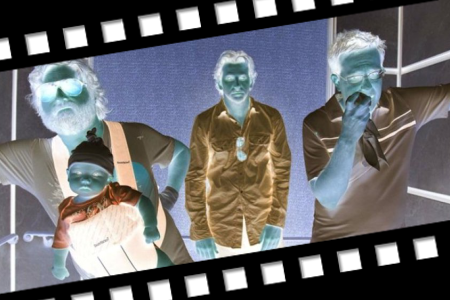

CINEMANIA: Guess the movie title
[6415] CINEMANIA: Guess the movie title - See negative of movie scene and guess the title. Length of words in solution: 3,8 - #brainteasers #movie #film #cinemania - Correct Answers: 46 - The first user who solved this task is Nasrin 24 T
BRAIN TEASERS
enter your answer and press button OK

CINEMANIA: Guess the movie title

See negative of movie scene and guess the title. Length of words in solution: 3,8
Correct answers: 46
The first user who solved this task is Nasrin 24 T.
#brainteasers #movie #film #cinemania
Register with your Google Account and start collecting points.
Check your ranking on list.

Learning From Teachers

Eight-year-old Sally brought her report card home from school. Her marks were good...mostly A's and a couple of B's.
However, her teacher had written across the bottom: "Sally is a smart little girl, but she has one fault. She talks too much in school. I have an idea I am going to try, which I think may break her of the habit."
Sally's dad signed her report card, putting a note on the back: "Please let me know if your idea works on Sally because I would like to try it out on her mother."  

Jokes of the day - Daily updated jokes. New jokes every day.
Follow Brain Teasers on social networks

Brain Teasers

puzzles, riddles, mathematical problems, mastermind, cinemania...

Wilhelm Schmidt

Born 16 Feb 1868; died 10 Feb 1954 at age 85.German anthropologist was a Roman Catholic priest whose research focussed on the origin of the idea of God and religion within various cultures, trying to link what emerged from ethnological studies with what is stated in the Bible. Schmidt proposed theories on the effect of environment in the evolution of families. He extensively studied ethnography particularly "culture circles," a series of four main stages that the base cultures of this world went through: Primitive (hunter-gatherer), Primary (horticulturists), Secondary (pastoralists) and lastly Tertiary (modern society). Others had proposed such a theory earlier, but Schmidt's work increased its popularity and acceptance. He founded the journal Anthropos (1906).«
This site uses cookies to store information on your computer. Some are essential to help the site properly. Others give us insight into how the site is used and help us to optimize the user experience. See our privacy policy.