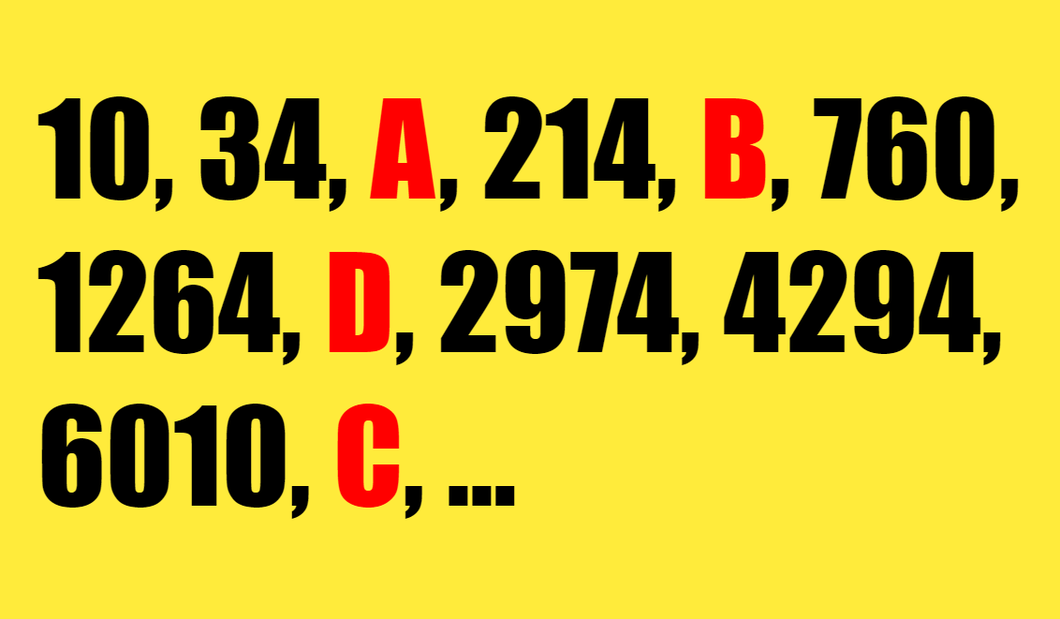
Calculate A+B*C*D
Look at the series (10, 34, A, 214, B, 760, 1264, D, 2974, 4294, 6010, C, ...), determine the pattern, and find the unknown values (A, B, C and D) and calculate A+B*C*D!
What Men Call their Women
Darling — Depends on how he says it. If he stresses the first syllable, then he's probably done something wrong or wants money.
Dear — Probably a leftover from his parents. Expect him to wear woolly cardigans, smoke a pipe and prefer a mug of Ovaltine to lager.
Sweetheart — If it's said patronizingly, it's not so sweet. But when uttered in earnest, it may send your own sweet heart aflutter.
Babe — Not to be confused with the film of the same name. Check for flares or signs that he's a 70s throwback. He's a bit of a medallion man. Chances are he's got his initials on his chunky ring. Leave immediately if he tries to sell you a second-hand car.
Baby doll — This type of man will probably require you to wear transparent frilly nighties even in the dead of winter. He doesn't want you to grow up, and obviously can't deal with real women.
Princess — Never trust a man who calls you princess. You may think you're being treated like royalty, but beware of Prince Charmings – they may be secretly plotting your over- throw.
Sexy — Fine if you're sexy. If you're not, who cares? He probably thinks you are anyway!!
My girlfriend — He's honest, open and probably glad to have you around. The next thing you know he'll be using your name!
The wife — If you're married then he probably thinks he owns you. If you're not, he probably thinks you act like his wife, in which case, he thinks he owns you.
My other half — You complete the set – he's only half a man without you. But it may make you feel as though you are losing your identity somewhere.
The missus — See The Wife.
My partner — He's right on. Probably likes eating tofu and hugging trees.
My significant other — He's even more right on. Probably thinks it's cruel to eat tofu and that trees need their own space.
She who must be obeyed — He thinks you're a nag, but probably doesn't lift a finger around the house.