Can you find the numbers ABC...
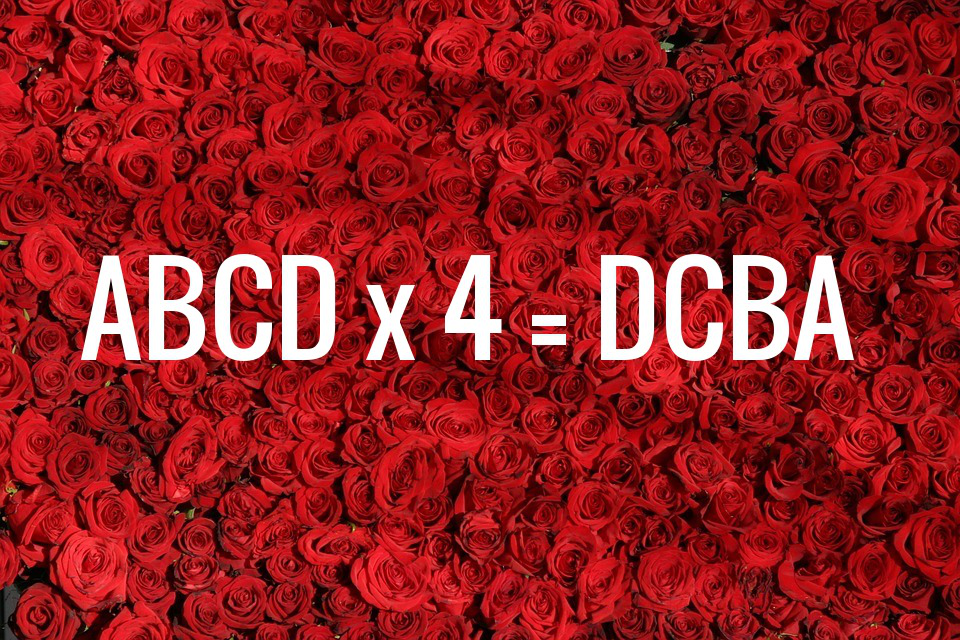
[3364] Can you find the numbers ABC... - Can you find the numbers ABCD so that the following calculation is proved? (ABCD x 4 = DCBA) - #brainteasers #math #riddles - Correct Answers: 50 - The first user who solved this task is aysan saidie
BRAIN TEASERS
enter your answer and press button OK

Can you find the numbers ABC...

Can you find the numbers ABCD so that the following calculation is proved? (ABCD x 4 = DCBA)
Correct answers: 50
The first user who solved this task is aysan saidie.
#brainteasers #math #riddles
Register with your Google Account and start collecting points.
Check your ranking on list.

A man goes to get his salary c...

A man goes to get his salary cheque and when he opens it he discovers that his employer has overpaid him by £2000.
He decides not to tell anybody and keeps quiet.
At the end of the following month when he opens the cheque, he sees that he's been underpaid by £2000.
Fuming, he goes to have it out with his employer. "Sir, I think you've made a mistake on my cheque."
"And how do you figure that?" his employer asks.
"It seems I've been underpaid by £2000."
"So?"
"No disrespect Sir, but I want my money."
"Last month I overpaid you by £2000 and you didn't complain so why now?"
"Well Sir, thing is I don't mind if you make a mistake once but if it becomes a habit I have to say something."
Jokes of the day - Daily updated jokes. New jokes every day.
Follow Brain Teasers on social networks

Brain Teasers

puzzles, riddles, mathematical problems, mastermind, cinemania...

Royal Greenwich Observatory

In 1675, the Royal Greenwich Observatory was created by Royal Warrant in England by Charles II. Building designed by Sir Christopher Wren (who was also a Professor of Astronomy) was commenced 10 Aug 1675 and finished the following year by John Flamsteed was appointed as the first Astronomer Royal. Its primary uses were in practical astronomy - navigation, timekeeping, determination of star positions. In 1767 the observatory began publishing The Nautical Almanac, which established the longitude of Greenwich as a baseline for time calculations. The almanac's popularity among navigators led in part to the adoption (1884) of the Greenwich meridian as the Earth's prime meridian (0° longitude) and the international time zones.
This site uses cookies to store information on your computer. Some are essential to help the site properly. Others give us insight into how the site is used and help us to optimize the user experience. See our privacy policy.