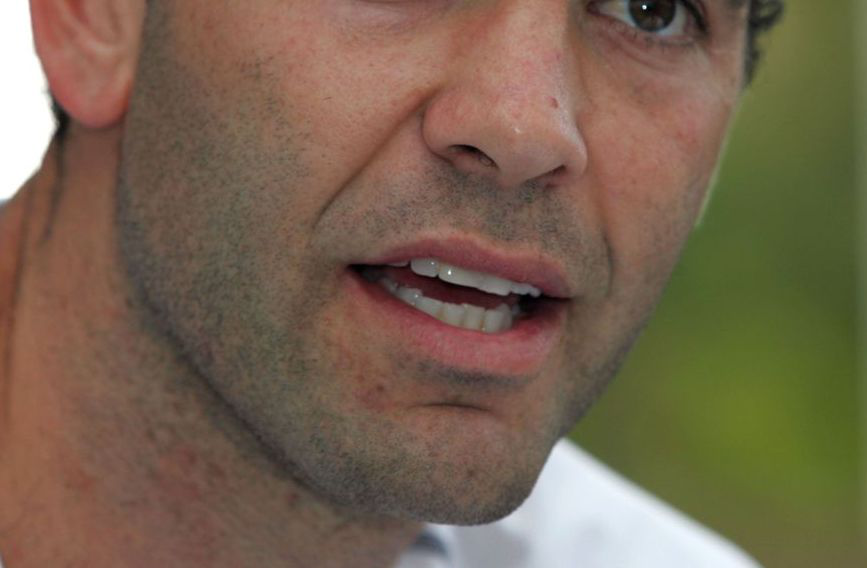
Can you name the athletes by the picture?
[2982] Can you name the athletes by the picture? - Can you name the athletes by the picture? - #brainteasers #riddles #sport - Correct Answers: 42 - The first user who solved this task is Дејан Шкребић
BRAIN TEASERS
enter your answer and press button OK

Can you name the athletes by the picture?

Can you name the athletes by the picture?
Correct answers: 42
The first user who solved this task is Дејан Шкребић.
#brainteasers #riddles #sport
Register with your Google Account and start collecting points.
Check your ranking on list.

A Very Minor Sin

A famous professor of surgery died and went to heaven. At the pearly gates he was asked by the gatekeeper, "Have you ever committed a sin you truly regret?""Yes," the professor answered. "When I was a young candidate at the Hospital of Saint Lucas, we played soccer against a team from the Community Hospital, and I scored a goal, which was off-side. But the referee did not see it, and the goal won us the match. I regret that now."
"Well," said the gatekeeper. "That is a very minor sin. You may enter."
"Thank you very much, Saint Peter," the professor answered.
"You're welcome, but I am not Saint Peter," said the gatekeeper. "He is having his lunch break. I am Saint Lucas."
Jokes of the day - Daily updated jokes. New jokes every day.
Follow Brain Teasers on social networks

Brain Teasers

puzzles, riddles, mathematical problems, mastermind, cinemania...

Friedrich Daniel von Recklinghausen

Born 2 Dec 1833; died 26 Aug 1910 at age 76.German pathologist, known by descriptions of two disorders, each called Recklinghausen's disease: multiple neurofibromatosis (1882), an inheritable disease characterized by café au lait spots combined with multiple peripheral nerve tumours and a variety of others dysplastic abnormalities of the skin, nervous system, bones, endocrine organs and blood vessels; and osteitis fibrosa cystica (1891), a now mostly historical term for a generalized rarefying bone disorder with skeletal deformation, seen in advanced hyperparathyroidism. He was a traditional histopathologist of his time, resistant to changes such as the use of the microtome or the results of the new science of bacteriology. He taught and remained active as a researcher until shortly before his death.
This site uses cookies to store information on your computer. Some are essential to help the site properly. Others give us insight into how the site is used and help us to optimize the user experience. See our privacy policy.