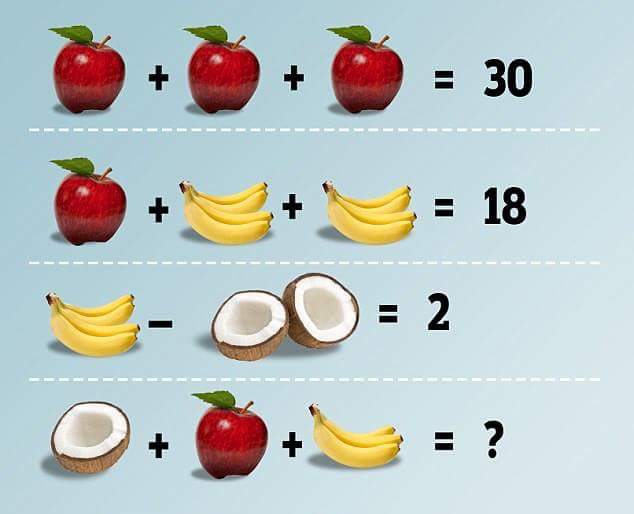
Can you replace the question...
[1947] Can you replace the question... - Can you replace the question mark with a number? - #brainteasers #math #riddles - Correct Answers: 217 - The first user who solved this task is Djordje Timotijevic
BRAIN TEASERS
enter your answer and press button OK

Can you replace the question...

Can you replace the question mark with a number?
Correct answers: 217
The first user who solved this task is Djordje Timotijevic.
#brainteasers #math #riddles
Register with your Google Account and start collecting points.
Check your ranking on list.

The Ring

An older, white haired man walked into a jewelry store one Friday evening with a beautiful young gal at his side.
He told the jeweler he was looking for a special ring for his girlfriend.
The jeweler looked through his stock and brought out a $5,000 ring and showed it to him.
The old man said, "I don't think you understand, I want something very special."
At that Statement, the jeweler went to his special stock and brought another ring over.
"Here's a stunning ring at only $40,000," the jeweler said. The young lady's eyes sparkled and her whole body trembled with excitement.
The old man seeing this said, "We'll take it."
The jeweler asked how payment would be made and the old man stated, by check. "I know you need to make sure my check is good, so I'll write it now and you can call the bank Monday to verify the funds and I'll pick the ring up Monday afternoon," he said.
Monday morning, a very teed-off jeweler phoned the old man. "There's no money in that account."
"I know," said the old man, "but can you imagine the weekend I had?"
Don't mess with Old People.      

Jokes of the day - Daily updated jokes. New jokes every day.
Follow Brain Teasers on social networks

Brain Teasers

puzzles, riddles, mathematical problems, mastermind, cinemania...

Argand diagram

In 1797, the concept of a geometrical interpretation of complex numbers was submitted by Caspar Wessel in a paper to a meeting of the Royal Danish Academy of Sciences.He represented complex numbers as points in a Cartesian plane, with the real portion of the number on the x axis and the imaginary part on the y axis. This was also independently devised a few years later, by Jean-Robert Argand, an amateur mathematician who self-published his ideas in an anomymous monograph(1806). Through publicity generated when Argand came forward and identified himself as the author, it was his name that has the lasting association with the Argand diagram.«
This site uses cookies to store information on your computer. Some are essential to help the site properly. Others give us insight into how the site is used and help us to optimize the user experience. See our privacy policy.