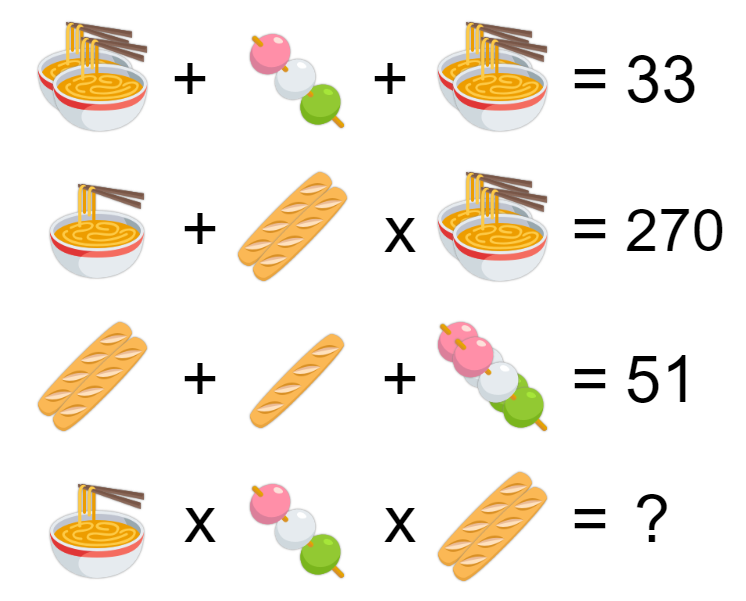
Can you replace the question mark with a number?
[6515] Can you replace the question mark with a number? - MATH PUZZLE: Can you replace the question mark with a number? - #brainteasers #math #riddles - Correct Answers: 43 - The first user who solved this task is Nílton Corrêa de Sousa
BRAIN TEASERS
enter your answer and press button OK

Can you replace the question mark with a number?

MATH PUZZLE: Can you replace the question mark with a number?
Correct answers: 43
The first user who solved this task is Nílton Corrêa de Sousa.
#brainteasers #math #riddles
Register with your Google Account and start collecting points.
Check your ranking on list.

A man is dining in a fancy res...

A man is dining in a fancy restaurant, and there is a gorgeous redhead sitting at the next table. He had been checking her out since he sat down, but lacked the nerve to talk with her.
Suddenly she sneezes and her glass eye comes flying out of its socket towards the man. He reflexively reaches out, grabs it out of the air, and hands it back.
"Oh my, I am so sorry," the woman says as she pops her eye back in place. "Let me buy you dessert to make it up to you."
They enjoy a wonderful dessert together, and afterwards, the woman invites him to the theater followed by drinks. After paying for everything, she asks him if he would like to come to her place for a nightcap...and stay for breakfast the next morning.
The next morning, she cooks a gourmet meal with all the trimmings. The guy is amazed! Everything has been incredible!
"You know," he said, "you are the perfect woman. Are you this nice to every guy you meet?"
"No," she replies...
... "You just happened to catch my eye
Jokes of the day - Daily updated jokes. New jokes every day.
Follow Brain Teasers on social networks

Brain Teasers

puzzles, riddles, mathematical problems, mastermind, cinemania...

Gilbert Newton Lewis

Died 23 Mar 1946 at age 70 (born 23 Oct 1875). American chemist who collaborated with Irving Langmuir in developing an atomic theory. He developed a theory of valency, which introduced the covalent bond (c. 1916), whereby a chemical combination is made between two atoms by the sharing of a pair of electrons, one contributed from each atom. This was part of his more general octet theory, published in Valence and the Structure of Atoms and Molecules (1923). Lewis visualized the electrons in an atom as being arranged in concentric cubes. The sharing of these electrons he illustrated in the Lewis dot diagrams familiar to chemistry students. He generalized the concept of acids and bases now known as Lewis acids and Lewis bases.«
This site uses cookies to store information on your computer. Some are essential to help the site properly. Others give us insight into how the site is used and help us to optimize the user experience. See our privacy policy.