Chess Knight Move
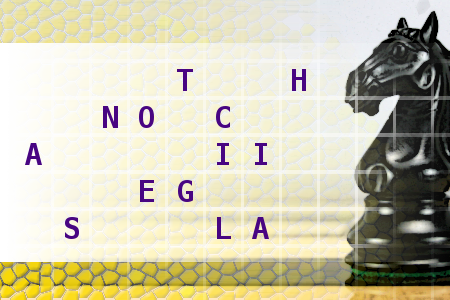
[1728] Chess Knight Move - Find the country and its capital city, using the move of a chess knight. First letter is C. Length of words in solution: 5,8. - #brainteasers #wordpuzzles #chessknightmove - Correct Answers: 65 - The first user who solved this task is Sanja Šabović
BRAIN TEASERS
enter your answer and press button OK

Chess Knight Move

Find the country and its capital city, using the move of a chess knight. First letter is C. Length of words in solution: 5,8.
Correct answers: 65
The first user who solved this task is Sanja Šabović.
#brainteasers #wordpuzzles #chessknightmove
Register with your Google Account and start collecting points.
Check your ranking on list.

Lawyer's Revenge

A lawyer's dog, running about unleashed, beelines for the local butcher shop and steals a roast off the counter.

The butcher goes to the lawyer's office and asks, "if a dog, running unleashed, steals a piece of meat from my store, do I have a right to demand payment for the meat from the dog's owner?" "Absolutely," the lawyer responded.

The butcher immediately shot back, "Good! You owe me $7.99 for the roast your dog stole from me this morning."

The lawyer, without a word, writes the butcher a check for $7.99. A few days later, the butcher, browsing through his mail, finds an envelope from the lawyer.

The contents read

"Consultation: $25.00."

Jokes of the day - Daily updated jokes. New jokes every day.
Follow Brain Teasers on social networks

Brain Teasers

puzzles, riddles, mathematical problems, mastermind, cinemania...

Joseph Erlanger

Born 5 Jan 1874; died 5 Dec 1965 at age 91.American physiologist who discovered that fibres within the same nerve cord possess different functions. In 1910 he accepted the chair of physiology at Washington University in St. Louis, which he held until his retirement in 1946. While his department became one of the major research centers in physiology in America. Erlanger continued his work on cardiovascular physiology. During WW I, he carried out research on the problem of shock. In 1921 he shifted his interests to neurophysiology, and began joint work, with colleague Herbert Gasser, on the amplification and recording of nerve action potentials with the cathode ray oscilloscope, for which they were awarded the Nobel Prize for Physiology or Medicine in 1944.
This site uses cookies to store information on your computer. Some are essential to help the site properly. Others give us insight into how the site is used and help us to optimize the user experience. See our privacy policy.