Chess Knight Move
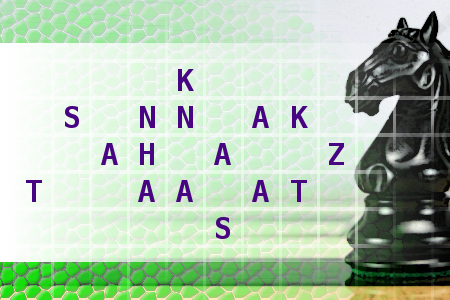
[2052] Chess Knight Move - Find the country and its capital city, using the move of a chess knight. First letter is K. Length of words in solution: 10,6. - #brainteasers #wordpuzzles #chessknightmove - Correct Answers: 64 - The first user who solved this task is Djordje Timotijevic
BRAIN TEASERS
enter your answer and press button OK

Chess Knight Move

Find the country and its capital city, using the move of a chess knight. First letter is K. Length of words in solution: 10,6.
Correct answers: 64
The first user who solved this task is Djordje Timotijevic.
#brainteasers #wordpuzzles #chessknightmove
Register with your Google Account and start collecting points.
Check your ranking on list.

Two elderly ladies had been fr...

Two elderly ladies had been friends for many decades. Over the years they had shared all kinds of activities and adventures. Lately, their activities had been limited to meeting a few times a week to play cards.
One day they were playing cards when one looked at the other and said, "Now don't get mad at me... I know we've been friends for a long time... but I just can't think of your name! I've thought and thought, but I can't remember it. Please tell me what your name is."
Her friend glared at her. For at least three minutes she just stared and glared at her. Finally she said, "How soon do you need to know"?
Jokes of the day - Daily updated jokes. New jokes every day.
Follow Brain Teasers on social networks

Brain Teasers

puzzles, riddles, mathematical problems, mastermind, cinemania...

Wilhelm Roux

Born 9 Jun 1850; died 15 Sep 1924 at age 74. German zoologist who was a founder of experimental embryology, by which he studied how organs and tissues are assigned their structural form and functions at the time of fertilization. In the 1880s, he experimented with frog eggs. He thought that mitotic cell division of the fertilized egg is the mechanism by which future parts of a developing organism are determined. He destroyed one of the two initial subdivisions (blastomeres) of a fertilized frog egg, obtaining half an embryo from the remaining blastomere. It seemed to him that determination of future parts and functions had already occurred in the two-cell stage and that each of the two blastomeres had already received the determinants necessary to form half the embryo. His theory was later negated by Hans Driesch.
This site uses cookies to store information on your computer. Some are essential to help the site properly. Others give us insight into how the site is used and help us to optimize the user experience. See our privacy policy.