Chess Knight Move
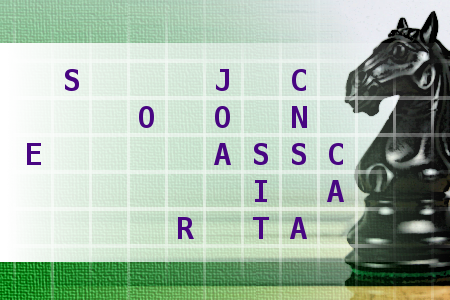
[3054] Chess Knight Move - Find the country and its capital city, using the move of a chess knight. First letter is C. Length of words in solution: 5,4,3,4. - #brainteasers #wordpuzzles #chessknightmove - Correct Answers: 46 - The first user who solved this task is On On Lunarbasil
BRAIN TEASERS
enter your answer and press button OK

Chess Knight Move

Find the country and its capital city, using the move of a chess knight. First letter is C. Length of words in solution: 5,4,3,4.
Correct answers: 46
The first user who solved this task is On On Lunarbasil.
#brainteasers #wordpuzzles #chessknightmove
Register with your Google Account and start collecting points.
Check your ranking on list.

Waiting for love

A fellow in a bar notices a woman, always alone, come in on a fairly regular basis. After the second week, he made his move.

"No thank you." she said politely. "This may sound rather odd in this day and age, but I'm keeping myself pure until I meet the man I love."

"That must be rather difficult." the man replied.

"Oh, I don't mind too much." she said. "But, it has my husband pretty upset."

Jokes of the day - Daily updated jokes. New jokes every day.
Follow Brain Teasers on social networks

Brain Teasers

puzzles, riddles, mathematical problems, mastermind, cinemania...

Georg von Kleist

Died 11 Dec 1748 (born c. 1700).Ewald Georg von Kleist was a German clergyman and physicist who was dean of the Cathedral of Kamin. Kleist experimented to store electric charge efficiently, and independently discovered (1745) the Leyden jar, an early form of thecapacitor, which in a different, miniature form is now an important electronic circuit component.The first Leyden jar was a stoppered glass jar partially filled with water with a wire or nail extending through the cork into the water. While holding the jar in one hand, the jar was charged by placing the end of the wire into contact with a static electricity producer, then removed. When Kleist touched the wire with his other hand, a discharge took place, giving himself a violent shock. The device was more thoroughly investigated by Pieter van Musschenbroek (1746).
This site uses cookies to store information on your computer. Some are essential to help the site properly. Others give us insight into how the site is used and help us to optimize the user experience. See our privacy policy.