Chess Knight Move
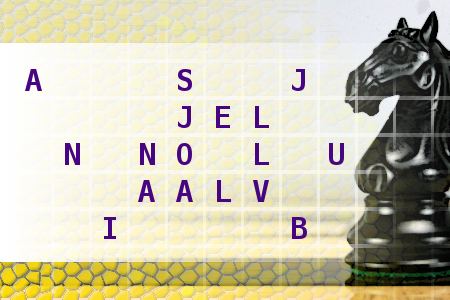
[3075] Chess Knight Move - Find the country and its capital city, using the move of a chess knight. First letter is S. Length of words in solution: 8,9. - #brainteasers #wordpuzzles #chessknightmove - Correct Answers: 48 - The first user who solved this task is On On Lunarbasil
BRAIN TEASERS
enter your answer and press button OK

Chess Knight Move

Find the country and its capital city, using the move of a chess knight. First letter is S. Length of words in solution: 8,9.
Correct answers: 48
The first user who solved this task is On On Lunarbasil.
#brainteasers #wordpuzzles #chessknightmove
Register with your Google Account and start collecting points.
Check your ranking on list.

An elderly lady was stopped to...

An elderly lady was stopped to pull into a parking space when a young man in his new red Mercedes went around her and parked in the space she was waiting for. The little old lady was so upset that she went up to the man and said, "I was going to park there!"
The man said, "That's what you can do when you're young and bright."
Well, this really upset the lady even more, so she got in her car and backed it up and then she stomped on the gas and plowed right into his Mercedes.
The young man ran back to his car and asked, "What did you do that for?"
The little old lady smiled and told him, "That's what you can do when you're old and rich!"
Jokes of the day - Daily updated jokes. New jokes every day.
Follow Brain Teasers on social networks

Brain Teasers

puzzles, riddles, mathematical problems, mastermind, cinemania...

Theodor Schwann

Born 7 Dec 1810; died 11 Jan 1882 at age 71. German physiologist who founded modern histology by defining the cell in Mikroskopische Untersuchungen (1839) as the basic unit of animal structure that makes elementary parts (such as teeth, bone, muscle, cartilage, nerve tissue) by cell differentiation. This laid the foundations for the cell theory. Schwann also worked on fermentation and discovered the enzyme pepsin. Schwann cells are named after him. He also investigated muscular contraction and nerve structure; discovered the striated muscle in the upper esophagus and the Schwann sheath; identified the role of microorganisms in putrefaction; formulated basic principles of embryology (that the egg is a single cell that develops into a complete organism); and coined the term metabolism.
This site uses cookies to store information on your computer. Some are essential to help the site properly. Others give us insight into how the site is used and help us to optimize the user experience. See our privacy policy.