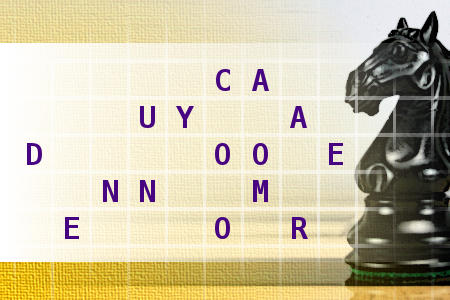

Chess Knight Move
Find the country and its capital city, using the move of a chess knight. First letter is C. Length of words in solution: 8,7.
Did You Know that in 2007 Mel Brooks
Started Nonprofit Foundation To Save Word 'Schmuck'
November 2007
NEW YORK—Saying he could no longer stand idly by while a vital part of American culture is lost forever, activist and Broadway producer Mel Brooks has founded a private nonprofit organization dedicated to preserving the word 'schmuck.'
An emotional Brooks stopped short of kvetching at a schmuck fundraiser Monday.
'Schmuck is dying,' a sober Brooks said during a 2,000-person rally held in his hometown of Williamsburg, Brooklyn Monday. 'For many of us, saying 'schmuck' is a way of life. Yet when I walk down the street and see people behaving in foolish, pathetic, or otherwise schmucky ways, I hear only the words 'prick' and 'douche bag.' I just shake my head and think, 'I don't want to live in a world like this.''The nonprofit, Schmucks For Schmuck, has compiled schmuck-related data from the past 80 years and conducted its own independent research on contemporary 'schmuck' usage. According to Brooks, the statistics are frightening: Utterances of the word 'schmuck' have declined every year since its peak in 1951, and in 2006, the word was spoken a mere 28 times—17 of these times by Brooks himself. The study indicates that today, when faced with a situation in which one can use a targeted or self-deprecating insult to convey a general feeling of disgust, people are 50 times more likely to use the word 'jerk' than 'schmuck,' 100 times more likely to use 'dick,' and 15,000 times more likely to use 'fucking asshole.'
The nonprofit, Schmucks For Schmuck, has compiled schmuck-related data from the past 80 years and conducted its own independent research on contemporary 'schmuck' usage. According to Brooks, the statistics are frightening: Utterances of the word 'schmuck' have declined every year since its peak in 1951, and in 2006, the word was spoken a mere 28 times—17 of these times by Brooks himself. The study indicates that today, when faced with a situation in which one can use a targeted or self-deprecating insult to convey a general feeling of disgust, people are 50 times more likely to use the word 'jerk' than 'schmuck,' 100 times more likely to use 'dick,' and 15,000 times more likely to use 'fucking asshole.'
Perhaps more startling, only 23 percent of men know what schmuck means, and only 1.2 percent of these men are under the age of 78. If such trends continue, Brooks estimates that by 2011, such lesser-used terms as 'imbecile,' 'dummy,' 'schlub,' and 'contemptible ne'er-do-well' will all surpass schmuck, which is projected to completely disappear by the year 2020 or whenever Brooks dies.
'We must save this word!' Brooks said to thunderous applause as those in attendance began chanting 'Schmuck! Schmuck! Schmuck!' 'How will we be able to charmingly describe someone who acts in an inappropriate manner? Especially given the tragic loss of the word 'schmegeggie' in 2001. So I urge you: Tonight, when you get home, please, call up your family, your friends, your loved ones, and tell them they're a bunch of schmucks.'
'I've never told anyone this before,' Brooks added, choking back tears, 'but my father was a schmuck.'
The foundation has already raised more than $20 million, thanks to donations from supporters such as Jackie Mason, Albert Brooks, the Schtupp Institute, Sen. Russ Feingold (D-WI), and the Henny Youngman Endowment for the Preservation of Schmekel. The money will go toward projects aimed at reintegrating 'schmuck' into the English lexicon, including billboards and flyers plastered with the word 'schmuck,' the upcoming 5K Schlep for Schmuck Awareness, and a new Mel Brooks film.