Chess Knight Move
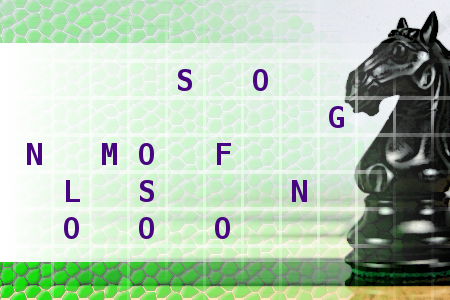
[5144] Chess Knight Move - Find the title of novel, using the move of a chess knight. First letter is S. Length of words in solution: 4,2,7. - #brainteasers #wordpuzzles #chessknightmove - Correct Answers: 35 - The first user who solved this task is Djordje Timotijevic
BRAIN TEASERS
enter your answer and press button OK

Chess Knight Move

Find the title of novel, using the move of a chess knight. First letter is S. Length of words in solution: 4,2,7.
Correct answers: 35
The first user who solved this task is Djordje Timotijevic.
#brainteasers #wordpuzzles #chessknightmove

Register with your Google Account and start collecting points.
Check your ranking on list.

I finally got one over

The other day, Louise and I got into some petty argument. (I say it was petty. She would have said it was Armageddon.) As is our nature, neither of us would admit the possibility that we might be in error.
To her credit, Louise finally said, 'Look. I'll tell you what. I'll admit I'm wrong if you admit I was right.'
'Fine.' I said.
She took a deep breath, looked me in the eye and said, 'I'm wrong.'
I grinned and replied, 'You're right.'

Jokes of the day - Daily updated jokes. New jokes every day.
Follow Brain Teasers on social networks

Brain Teasers

puzzles, riddles, mathematical problems, mastermind, cinemania...

Carl Wilhelm Scheele

Born 9 Dec 1742; died 21 May 1786 at age 43. (also Karl) Swedish chemist who discovered oxygen in 1772. Scheele, a keen experimenter, worked in difficult and often hazardous conditions. In his only book, Chemical Observations and Experiments on Air and Fire (1777), he stated that the atmosphere is composed of two gases, one supporting combustion, which he named "fire air" (oxygen), and the other preventing it, which he named "vitiated air" (nitrogen). Due to delay in his publication, he lost priority to Priestley's discovery of oxygen in 1774. Scheele discovered many substances, such as chlorine (1774), manganese (1774), tungsten (1781), molybdenum (1782), glycerol, hydrocyanic (prussic) acid, citric acid, hydrogen sulphide and hydrogen fluoride. He also discovered a process resembling pasteurization.
This site uses cookies to store information on your computer. Some are essential to help the site properly. Others give us insight into how the site is used and help us to optimize the user experience. See our privacy policy.