Chess Knight Move
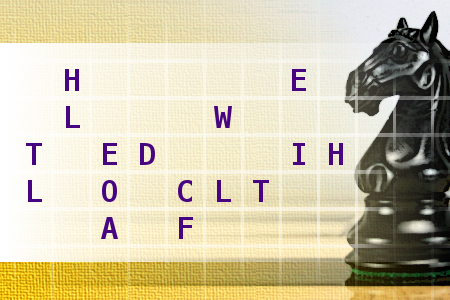
[5494] Chess Knight Move - Find the title of novel, using the move of a chess knight. First letter is T. Length of words in solution: 3,4,2,3,4. - #brainteasers #wordpuzzles #chessknightmove - Correct Answers: 23 - The first user who solved this task is Alfa Omega
BRAIN TEASERS
enter your answer and press button OK

Chess Knight Move

Find the title of novel, using the move of a chess knight. First letter is T. Length of words in solution: 3,4,2,3,4.
Correct answers: 23
The first user who solved this task is Alfa Omega.
#brainteasers #wordpuzzles #chessknightmove
Register with your Google Account and start collecting points.
Check your ranking on list.

Good thinking

Two brunettes and a blonde are driving in the desert when, all of a sudden, their car breaks down.

As none of them have any motoring knowledge, they decide to walk. Each of them decides to take one thing with her.

The first brunette takes some food in case she gets hungry, the second brunette takes some water in case she gets thirsty and the blonde takes a car door.

When questioned about her choice, the blonde replies:

"Well, if I get hot, I can roll down the window!"

Jokes of the day - Daily updated jokes. New jokes every day.
Follow Brain Teasers on social networks

Brain Teasers

puzzles, riddles, mathematical problems, mastermind, cinemania...

Optical pulsar identified

In 1969, an optical pulsar was identified for the first time by University of Arizona astronomers led by John Cocke and Michael Disney at the Steward Observatory. It was discovered in the Crab Nebula. Fourteen months before, the first type of pulsar to be discovered was in the radio spectrum and was detected on 28 Nov 1967 by Jocelyn Bell, a graduate student of Anthony Hewish. Most pulsars emit regular pulses of radio waves, some up to 1,000 pulses per second,. They are believed to be neutron stars with exceedingly rapid spin. Optical pulsarsflash at a similar rate, which is too fast for the eye to perceive. The Arizona astronomers used a stroboscopic technique to look at a known radio spectrum pulsar, at a time when an optical pulsar was only a theoretical question. Only a handful have been found since.«
This site uses cookies to store information on your computer. Some are essential to help the site properly. Others give us insight into how the site is used and help us to optimize the user experience. See our privacy policy.