Chess Knight Move
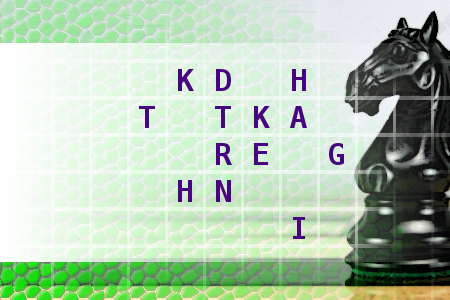
[6558] Chess Knight Move - Find the title of movie, using the move of a chess knight. First letter is T. Length of words in solution: 3,4,6. - #brainteasers #wordpuzzles #chessknightmove - Correct Answers: 16 - The first user who solved this task is Nasrin 24 T
BRAIN TEASERS
enter your answer and press button OK

Chess Knight Move

Find the title of movie, using the move of a chess knight. First letter is T. Length of words in solution: 3,4,6.
Correct answers: 16
The first user who solved this task is Nasrin 24 T.
#brainteasers #wordpuzzles #chessknightmove
Register with your Google Account and start collecting points.
Check your ranking on list.

The passenger tapped the cab d...

The passenger tapped the cab driver on the shoulder to askhim something. The driver screamed, lost control of the car,nearly hit a bus, went up on the sidewalk, and stoppedcentimetres from a shop window.
For a second everything went quiet in the cab, then thedriver said, "Look mister, don't ever do that again. Youscared the daylights out of me!"
The passenger apologized and said he didn't realize that alittle tap could scare him so much.
The driver replied, "You're right. I'm sorry, it's notreally your fault. Today is my first day as a cab driver.I've been driving a hearse for the last 25 years".
Jokes of the day - Daily updated jokes. New jokes every day.
Follow Brain Teasers on social networks

Brain Teasers

puzzles, riddles, mathematical problems, mastermind, cinemania...

Hideki Yukawa

Died 8 Sep 1981 at age 74 (born 23 Jan 1907). Japanese physician and physicist who shared the 1949 Nobel Prize for Physics for “his prediction of the existence of mesons on the basis of theoretical work on nuclear forces.” In his 1935 paper, On the Interaction of Elementary Particles*, he proposed a new field theory of nuclear forces that predicted the existence of the previously unknown meson. Mesons are particles heavier than electrons but lighter than protons. One type of meson was subsequently discovered in cosmic rays in 1937 by American physicists, encouraging him to further develop meson theory. From 1947, he worked mainly on the general theory of elementary particles in connection with the concept of the “non-local” field. He was the first Japanese Nobel Prize winner.«*Proc.Phys.-Math. Soc.Japan, 17, p. 48.
This site uses cookies to store information on your computer. Some are essential to help the site properly. Others give us insight into how the site is used and help us to optimize the user experience. See our privacy policy.