Find a famous person
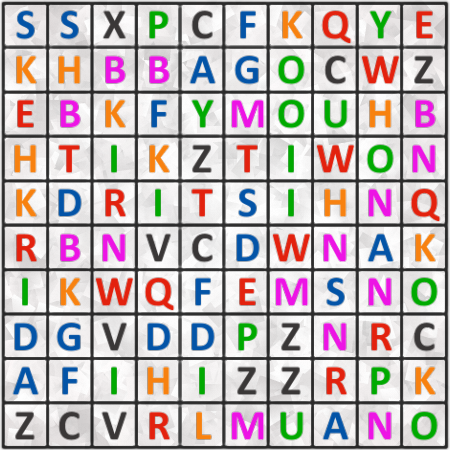
[1991] Find a famous person - Find the first and the last name of a famous person. Text may go in all 8 directions. Length of words in solution: 4,8. - #brainteasers #wordpuzzles - Correct Answers: 33 - The first user who solved this task is Djordje Timotijevic
BRAIN TEASERS
enter your answer and press button OK

Find a famous person

Find the first and the last name of a famous person. Text may go in all 8 directions. Length of words in solution: 4,8.
Correct answers: 33
The first user who solved this task is Djordje Timotijevic.
#brainteasers #wordpuzzles

Register with your Google Account and start collecting points.
Check your ranking on list.

Little Johnny attended a horse...

Little Johnny attended a horse auction with his father. He watched as his father moved from horse to horse, running his hands up and down the horse's legs and rump, and chest. After a few minutes, Johnny asked, "Dad, why are you doing that?"
His father replied, "Because when I'm buying horses, I have to make sure that they are healthy and in good shape before I buy."
Johnny, looking worried, said, "Dad, I think the UPS guy wants to buy Mom..."
Jokes of the day - Daily updated jokes. New jokes every day.
Follow Brain Teasers on social networks

Brain Teasers

puzzles, riddles, mathematical problems, mastermind, cinemania...

Karl Richard Lepsius

Born 23 Dec 1810; died 10 Jul 1884 at age 73.German Egyptologist who is regarded as a founding father of scientific methods in archaeology. His plans, maps and drawings of tomb and temple walls are of high accuracy and reliability. In 1842, he headed a team of carefully chosen specialists on a four year expedition to the Nile Valley sponsored by King Fredrich Wilhelm IV of Prussia. Lepsius explored Khartoum and Sennar, during which he collected 15,000 artifacts and dispatched for display in Berlin. In winter 1844-45, Lepsius travelled throughout the Valley of the Kings, recording numerous scenes and inscriptions. He returned in 1866 and found the Canopus decree at Tanis. Being written in two languages, it was a valuable cross-reference for the prior interpretation of the Rosetta stone by Champollion.«
This site uses cookies to store information on your computer. Some are essential to help the site properly. Others give us insight into how the site is used and help us to optimize the user experience. See our privacy policy.