Find a famous person
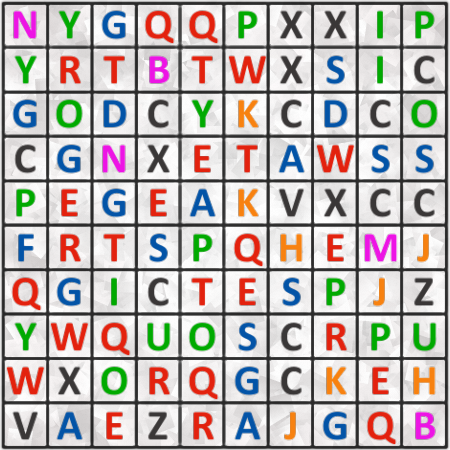
[3247] Find a famous person - Find the first and the last name of a famous person. Text may go in all 8 directions. Length of words in solution: 7,4. - #brainteasers #wordpuzzles - Correct Answers: 36 - The first user who solved this task is On On Lunarbasil
BRAIN TEASERS
enter your answer and press button OK

Find a famous person

Find the first and the last name of a famous person. Text may go in all 8 directions. Length of words in solution: 7,4.
Correct answers: 36
The first user who solved this task is On On Lunarbasil.
#brainteasers #wordpuzzles
Register with your Google Account and start collecting points.
Check your ranking on list.

Why do you want a divorce?

A judge was interviewing a woman regarding her pending divorce, and asked, "What are the grounds for your divorce?"

She replied, "About four acres and a nice little home in the middle of the property with a stream running by."

"No," he said, "I mean what is the foundation of this case?"

"It is made of concrete, brick and mortar," she responded.

"I mean," he continued, "What are your relations like?"

"I have an aunt and uncle living here in town, and so do my husband's parents."

He said, "Do you have a real grudge?"

"No," she replied, "We have a two-car carport and have never really needed one."

"Please," he tried again, "is there any infidelity in your marriage?"

"Yes, both my son and daughter have stereo sets. We don't necessarily like the music, but the answer to your questions is yes."

"Ma'am, does your husband ever beat you up?"

"Yes," she responded, "about twice a week he gets up earlier than I do."

Finally, in frustration, the judge asked, "Lady, why do you want a divorce?"

"Oh, I don't want a divorce," she replied. "I've never wanted a divorce. My husband does. He said he can't communicate with me!"

Jokes of the day - Daily updated jokes. New jokes every day.
Follow Brain Teasers on social networks

Brain Teasers

puzzles, riddles, mathematical problems, mastermind, cinemania...

Sir Francis Bacon

Born 22 Jan 1561; died 9 Apr 1626 at age 65. English philosopher remembered for his influence promoting a scientific method. He held that the aim of scientific investigation is practical application of the understanding of nature to improve man's condition. He wrote that scientists should concentrate on certain important kinds of experimentally reproducible situations, (which he called "prerogative instances"). After tabulating such phenomena, the investigator should also aim to make a gradual ascent to more and more comprehensive laws, and will acquire greater and greater certainty as he or she moves up the pyramid of laws. At the same time each law that is reached should lead him to new kinds of experiment, that is, to kinds of experiment over and above those that led to the discovery of the law.
This site uses cookies to store information on your computer. Some are essential to help the site properly. Others give us insight into how the site is used and help us to optimize the user experience. See our privacy policy.