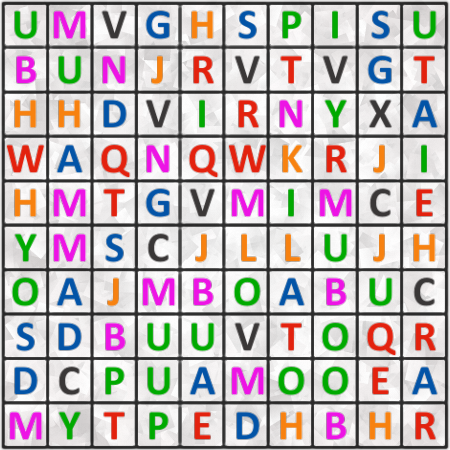
Find a famous person
[3412] Find a famous person - Find the first and the last name of a famous person. Text may go in all 8 directions. Length of words in solution: 8,3. - #brainteasers #wordpuzzles - Correct Answers: 37 - The first user who solved this task is On On Lunarbasil
BRAIN TEASERS
enter your answer and press button OK

Find a famous person

Find the first and the last name of a famous person. Text may go in all 8 directions. Length of words in solution: 8,3.
Correct answers: 37
The first user who solved this task is On On Lunarbasil.
#brainteasers #wordpuzzles

Register with your Google Account and start collecting points.
Check your ranking on list.

An investment counselor decide...

An investment counselor decided to go out on her own. She was shrewd and diligent, so business kept coming in, and pretty soon she realized that she needed an in-house counsel. She began to interview young lawyers.
"As I'm sure you can understand," she started off with one of the first applicants, "in a business like this, our personal integrity must be beyond question." She leaned forward. "Mr. Peterson, are you an honest lawyer?"
"Honest?" replied the job prospect. "Let me tell you something about honest. Why, I'm so honest that my father lent me $15,000 for my education, and I paid back every penny the minute I tried my very first case."
"Impressive. And what sort of case was that?"
The lawyer squirmed in his seat and admitted, "He sued me for the money."
Jokes of the day - Daily updated jokes. New jokes every day.
Follow Brain Teasers on social networks

Brain Teasers

puzzles, riddles, mathematical problems, mastermind, cinemania...

Albert Wallace Hull

Born 19 Apr 1880; died 22 Jan 1966 at age 85.American physicist who independently discovered the powder method of X-ray analysis of crystals (1917), which permits the study of crystalline materials in a finely divided microcrystalline, or powder, state. His first work was on electron tubes, X-ray crystallography, and (during WW II) piezoelectricity. In the 1920's, he studied noise measurements in diodes and triodes. In the 1930's, he also took interest in metallurgy and glass science. His best-known work was done after the war, especially his classic paper on the effect of a uniform magnetic field on the motion of electrons between coaxial cylinders. He also invented the magnetron (1921) and the thyratron (1927), and other electron tubes with wide application as components in electronic circuits.
This site uses cookies to store information on your computer. Some are essential to help the site properly. Others give us insight into how the site is used and help us to optimize the user experience. See our privacy policy.