
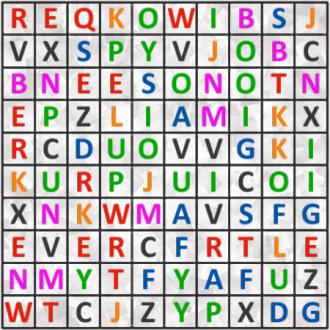
Find a famous person
[3722] Find a famous person - Find the first and the last name of a famous person. Text may go in all 8 directions. Length of words in solution: 4,6. - #brainteasers #wordpuzzles - Correct Answers: 29 - The first user who solved this task is On On Lunarbasil
BRAIN TEASERS
enter your answer and press button OK

Find a famous person

Find the first and the last name of a famous person. Text may go in all 8 directions. Length of words in solution: 4,6.
Correct answers: 29
The first user who solved this task is On On Lunarbasil.
#brainteasers #wordpuzzles
Register with your Google Account and start collecting points.
Check your ranking on list.

With no warning and clear out...

With no warning and clear out of the blue, a husband said to his wife, "Honey, I have invited a friend home for supper tonight."
His wife replied, "What? Are you crazy? The house is a mess, I didn't have time to go shopping, all the dishes are dirty, and I don't feel like cooking a fancy meal tonight!"
The husband said, "I know all that."
"Then why in the world did you invite your friend for supper tonight?" asked the wife.
The guy answered, "Because the poor fool is thinking about getting married."
Jokes of the day - Daily updated jokes. New jokes every day.
Follow Brain Teasers on social networks

Brain Teasers

puzzles, riddles, mathematical problems, mastermind, cinemania...

Helium liquefied

In 1908, Kamerlingh Onnes made helium liquid at a temperature of 4.2 K (about -269 ºC). He had worked for many years to liquify this element which persisted as a gas to the lowest temperature. Using liquid air to produce liquid hydrogen and then the hydrogen to jacket the liquification apparatus, he produced about 60 cubic centimeters of liquid helium. The gas was liquefied by compressing it, cooling it below the inversion temperature and then allowing it to expand, which causes further cooling resulting in the liquefaction of some of the gas. At his cryogenic laboratory, he had previously liquefied air (1892) in large quantities, and built a large hydrogen liquefier (1906). Onnes received the Nobel Prize in 1913 for his low temperature work.
This site uses cookies to store information on your computer. Some are essential to help the site properly. Others give us insight into how the site is used and help us to optimize the user experience. See our privacy policy.