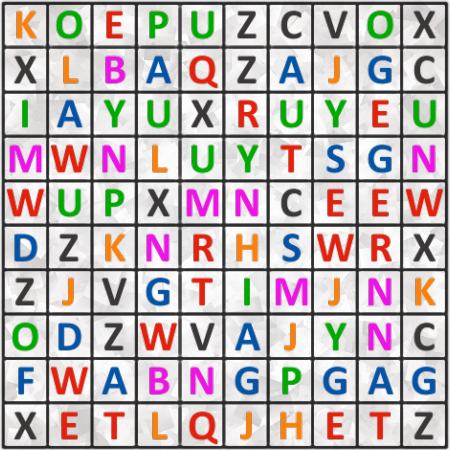
Find a famous person
[4247] Find a famous person - Find the first and the last name of a famous person. Text may go in all 8 directions. Length of words in solution: 4,6. - #brainteasers #wordpuzzles - Correct Answers: 23 - The first user who solved this task is H Tav
BRAIN TEASERS
enter your answer and press button OK

Find a famous person

Find the first and the last name of a famous person. Text may go in all 8 directions. Length of words in solution: 4,6.
Correct answers: 23
The first user who solved this task is H Tav.
#brainteasers #wordpuzzles
Register with your Google Account and start collecting points.
Check your ranking on list.

Smart kid

Bill and Marla decided that the only way to pull off a Sunday afternoon quickie with their ten-year-old son in the apartment was to send him out on the balcony and tell him to report on all the neighborhood activities.

The boy began his commentary as his parents put their plan into operation. "There's a car being towed from the parking lot," he said. "An ambulance just drove by." A few moments passed.

"Looks like the Andersons have company," he called out. "Matt's riding a new bike, and the Coopers are having sex."

Mom and Dad shot up in bed. "How do you know that?" the startled father asked.

"Their kid is standing out on the balcony too," his son replied.

Jokes of the day - Daily updated jokes. New jokes every day.
Follow Brain Teasers on social networks

Brain Teasers

puzzles, riddles, mathematical problems, mastermind, cinemania...

Herbert Copeland

Born 21 May 1902; died 15 Oct 1968 at age 66.Herbert Faulkner Copeland was an American biologist who delineated four biological kingdoms, instead of just two for plants and animals. A decade after Darwin's Origin of Species, Ernst Haekel had proposed (1866) adding a kingdom, Protista, for microorganisms, but it wasn't accepted. Copeland further discriminated among the microorganisms in a paper in 1938, splitting them into two kingdoms: Monera and Protista. Copeland identified Monera as organisms without nuclei, and Protista as being largely unicellular, with nuclei. By 1956, he published a book,The Classification of Lower Organisms, still trying “to pursuade the community of biologists” to adopt these four kingdoms. Change came slowly, and continues beyond Copeland's ideas to now five or six. He was the son of botanist Edwin B. Copeland, from whom he learned the principles of classification.«
This site uses cookies to store information on your computer. Some are essential to help the site properly. Others give us insight into how the site is used and help us to optimize the user experience. See our privacy policy.