Find a famous person
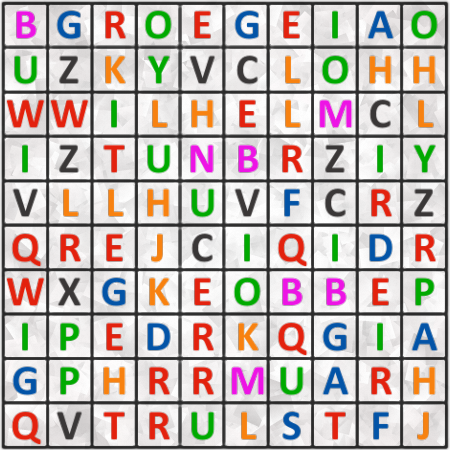
[4691] Find a famous person - Find the first and the last name of a famous person. Text may go in all 8 directions. Length of words in solution: 5,7,9,5. - #brainteasers #wordpuzzles - Correct Answers: 23 - The first user who solved this task is Djordje Timotijevic
BRAIN TEASERS
enter your answer and press button OK

Find a famous person

Find the first and the last name of a famous person. Text may go in all 8 directions. Length of words in solution: 5,7,9,5.
Correct answers: 23
The first user who solved this task is Djordje Timotijevic.
#brainteasers #wordpuzzles
Register with your Google Account and start collecting points.
Check your ranking on list.

Jigsaw puzzle

A group of girls walks into a bar. One of the women tells the bartender to line up a row of drinks for all of them. The gals lift their glasses and toast: "Here's to 51 days!" and they proceed to down their drinks.

Once again, they tell the bartender to "line 'em up" and once again they toast 51 days and down their drinks.

The bartender says: "I don’t get it. Why in the world are you toasting 51 days?"

One of the girl explains: "We just finished a jigsaw puzzle. It had written on the box '2-4 years' but we finished it in only 51 days!"

Jokes of the day - Daily updated jokes. New jokes every day.
Follow Brain Teasers on social networks

Brain Teasers

puzzles, riddles, mathematical problems, mastermind, cinemania...

Gottfried Wilhelm Leibniz

Born 1 Jul 1646; died 14 Nov 1716 at age 70. German philosopher, mathematician and political adviser, important both as a metaphysician and as a logician, and also distinguished for his independent invention of the differential and integral calculus. Through meeting with such scholars as Christiaan Huygens in Paris and with members of the Royal Society, including Robert Boyle, during two trips to London in 1673 and 1676, Leibniz was introduced to the outstanding problems challenging the mathematicians and physicists of Europe. Leibniz's independently discovered differential and integral calculus (published 1684), but became involved in a bitter priority dispute with Isaac Newton, whose ideas on the calculus were developed earlier (1665), but published later (1687).
This site uses cookies to store information on your computer. Some are essential to help the site properly. Others give us insight into how the site is used and help us to optimize the user experience. See our privacy policy.