Find a famous person
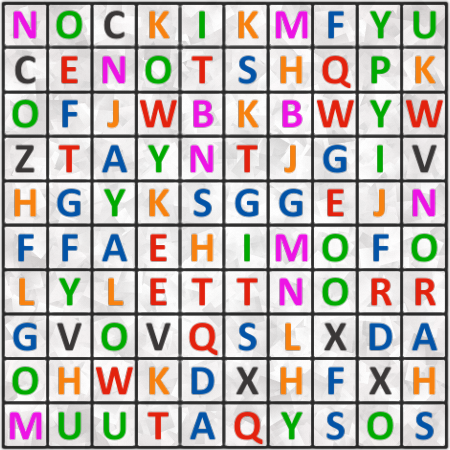
[5342] Find a famous person - Find the first and the last name of a famous person. Text may go in all 8 directions. Length of words in solution: 6,5. - #brainteasers #wordpuzzles - Correct Answers: 26 - The first user who solved this task is Djordje Timotijevic
BRAIN TEASERS
enter your answer and press button OK

Find a famous person

Find the first and the last name of a famous person. Text may go in all 8 directions. Length of words in solution: 6,5.
Correct answers: 26
The first user who solved this task is Djordje Timotijevic.
#brainteasers #wordpuzzles

Register with your Google Account and start collecting points.
Check your ranking on list.

How retired folks stay happy and occupied

Working people frequently ask retired people what they do to make their days interesting.

Well, for example, the other day, Mary my wife and I went into town and visited a shop. We were only in there for about 5 minutes. When we came out, there was a cop writing out a parking ticket.

We went up to him and I said, 'Come on, man, how about giving a senior citizen a break?'
He ignored us and continued writing the ticket. I called him a dumb ass. He glared at me and started writing another ticket for having worn-out tires.
So Mary called him a shit head.  He finished the second ticket and put it on the windshield with the first.
Then he started writing a third ticket.
This went on for about 20 minutes.
The more we abused him, the more tickets he wrote.

Just then our bus arrived, and we got on it and went home. We try to have a little fun each day now that we're retired. It's important at our age.

Jokes of the day - Daily updated jokes. New jokes every day.
Follow Brain Teasers on social networks

Brain Teasers

puzzles, riddles, mathematical problems, mastermind, cinemania...

Thin-film memory

In 1960, the first electronic computer to employ thin-film memory was announced when Sperry Rand Corporation, of St. Paul, Minn., unveiled a new computer, known as Univac 1107 [left]. Thin film magnetic memory technology was developed by Sperry Rand through government funded research. A thin film (4 millionths of an inch thick) of iron-nickel alloy was deposited on small glass plates. This provided very fast access times in the range of 0.67 microseconds, but was very expensive to produce. The Univac 1107, intended for the civilian marketplace, used thin film memory only for its 128-word general register stack. Military computers, where money was less of a concern, used larger amounts of thin film memory.
This site uses cookies to store information on your computer. Some are essential to help the site properly. Others give us insight into how the site is used and help us to optimize the user experience. See our privacy policy.