Find a famous person
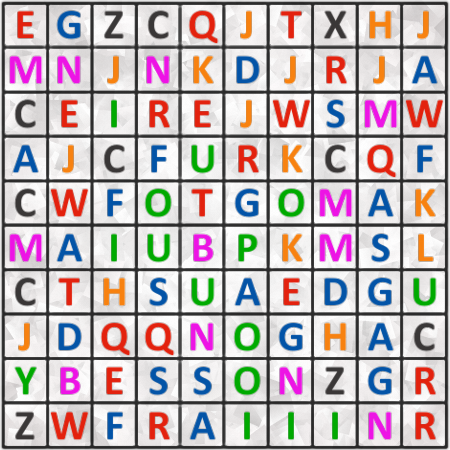
[5486] Find a famous person - Find the first and the last name of a famous person. Text may go in all 8 directions. Length of words in solution: 3,6. - #brainteasers #wordpuzzles - Correct Answers: 16 - The first user who solved this task is Djordje Timotijevic
BRAIN TEASERS
enter your answer and press button OK

Find a famous person

Find the first and the last name of a famous person. Text may go in all 8 directions. Length of words in solution: 3,6.
Correct answers: 16
The first user who solved this task is Djordje Timotijevic.
#brainteasers #wordpuzzles
Register with your Google Account and start collecting points.
Check your ranking on list.

Smashing The Cigarettes

A carpet layer had just finished installing carpet for a lady. He stepped out for a smoke, only to realize he'd lost his cigarettes. In the middle of the room, under the carpet, was a bump. "No sense pulling up the entire floor for one pack of smokes," he said to himself. He proceeded to get out his hammer and flattened the hump.
As he was cleaning up, the lady came in. "Here," she said, handing him his pack of cigarettes. "I found them in the hallway." "Now," she said, "if only I could find my gerbil."

Jokes of the day - Daily updated jokes. New jokes every day.
Follow Brain Teasers on social networks

Brain Teasers

puzzles, riddles, mathematical problems, mastermind, cinemania...

Lowest temperature ever

In 1994, the National Institute of Standards and Technology (NIST) issued a press release that physicists there recently cooled atoms to 700 nanokelvins, the coldest temperature ever recorded for matter. NIST scientists chilled a cloud of cesium atoms very close to absolute zero using lasers to catch the atoms in an optical lattice. The atoms reached 700 nanokelvins, or 700 billionths of a degree above absolute zero. Zero kelvin (-273ºC), or absolute zero, is the temperature at which atomic thermal motion would cease. Since the late 1970s, physicists have sought to use lasers to cool atoms closer to absolute zero, primarily for improving atomic timekeeping, certain experimental measurements and lithography processes for the semiconductor industry.
This site uses cookies to store information on your computer. Some are essential to help the site properly. Others give us insight into how the site is used and help us to optimize the user experience. See our privacy policy.