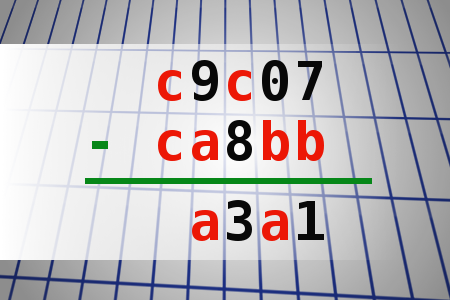
Find number abc
[2003] Find number abc - If c9c07 - ca8bb = a3a1 find number abc. Multiple solutions may exist. - #brainteasers #math - Correct Answers: 69 - The first user who solved this task is Djordje Timotijevic
BRAIN TEASERS
enter your answer and press button OK

Find number abc

If c9c07 - ca8bb = a3a1 find number abc. Multiple solutions may exist.
Correct answers: 69
The first user who solved this task is Djordje Timotijevic.
#brainteasers #math

Register with your Google Account and start collecting points.
Check your ranking on list.

I’m worried about your heart...

I’m worried about your heart murmur,” the doc told Jack. “I’ve always had a heart murmur,” Jack protested. “Yeah,” replied the doc, “but now the murmur has started humming.” “That doesn’t sound good!” Jack was getting worried now. “It’s worse than you think,” the doc said. “It’s humming ‘Nearer My God to Thee.’”
Jokes of the day - Daily updated jokes. New jokes every day.
Follow Brain Teasers on social networks

Brain Teasers

puzzles, riddles, mathematical problems, mastermind, cinemania...

Virus DNA

In 1944, DNA was identified as the hereditary agent in a virus, published in a report by O.T. Avery, Colin MacLeod, and Maclyn McCarty. This crucial discovery in molecular genetics - that genetic information is carried in the nucleotide sequence of DNA - arose incidentally while studying pneumococcus to monitor the epidemic spread of pneumonia. Since 1928, when British physician Frederick Griffith had found that extracts of a pathogenic strain of that virus could transform a harmless strain into a pathogenic one, scientists had searched for the "transforming factor." The work by Avery, et al., now identified the transforming molecule as DNA, having ruled out, through extract digestions, RNA, protein, and polysaccharide capsular material.[Ref.: Studies on the chemical nature of the substance inducing transformation of pneumococcal types. Induction of transformation by a deoxyribonucleic acid fraction isolated from pneumococcus type III. Journal of Experimental Medicine. 79:137-158., issue of 1 Feb 1944]
This site uses cookies to store information on your computer. Some are essential to help the site properly. Others give us insight into how the site is used and help us to optimize the user experience. See our privacy policy.