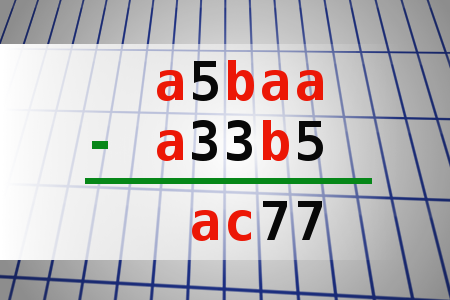
Find number abc
[2805] Find number abc - If a5baa - a33b5 = ac77 find number abc. Multiple solutions may exist. - #brainteasers #math - Correct Answers: 80 - The first user who solved this task is Roxana zavari
BRAIN TEASERS
enter your answer and press button OK

Find number abc

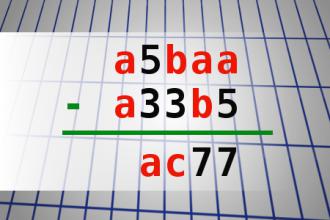
If a5baa - a33b5 = ac77 find number abc. Multiple solutions may exist.
Correct answers: 80
The first user who solved this task is Roxana zavari.
#brainteasers #math
Register with your Google Account and start collecting points.
Check your ranking on list.

Unusual affair

Paddy and his two friends are talking at a bar.

His first friend says, “I think my wife is having an affair with the electrician. The other day I came home and found wire cutters under our bed and they weren’t mine.”

His second friend says, “I think my wife is having an affair with the plumber the other day I found a wrench under the bed and it wasn’t mine.”

Paddy says, “I think my wife is having an affair with a horse.”

Both his friends look at him with utter disbelief.

“No, I’m serious,” Paddy says. “The other day I came home and found a jockey under our bed.”

Jokes of the day - Daily updated jokes. New jokes every day.
Follow Brain Teasers on social networks

Brain Teasers

puzzles, riddles, mathematical problems, mastermind, cinemania...

Beagle voyage begins

In 1831, Charles Darwin set sail from Plymouth harbour on his voyage of scientific discovery aboard the HMS Beagle, a British Navy ship. The Captain Robert FitzRoy was sailing to the southern coast of South America in order to complete a government survey. Darwin had an unpaid position as the ship's naturalist, at age 22, just out of university. Originally planned to be at sea for two years, the voyage lasted five years, making stops in Brazil, the Galapogos Islands, and New Zealand. From the observations he made and the specimens he collected on that voyage, Darwin developed his theory of biological evolution through natural selection, which he published 28 years after the Beagle left Plymouth. Darwin laid the foundation of modern evolutionary theory
This site uses cookies to store information on your computer. Some are essential to help the site properly. Others give us insight into how the site is used and help us to optimize the user experience. See our privacy policy.