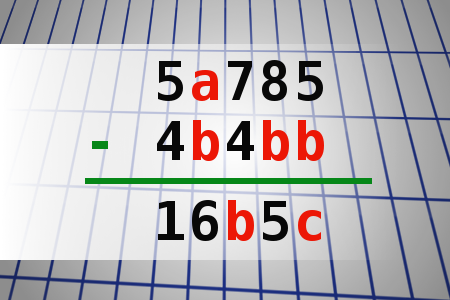
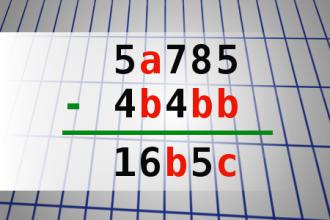
Find number abc
[3155] Find number abc - If 5a785 - 4b4bb = 16b5c find number abc. Multiple solutions may exist. - #brainteasers #math - Correct Answers: 57 - The first user who solved this task is Djordje Timotijevic
BRAIN TEASERS
enter your answer and press button OK

Find number abc

If 5a785 - 4b4bb = 16b5c find number abc. Multiple solutions may exist.
Correct answers: 57
The first user who solved this task is Djordje Timotijevic.
#brainteasers #math
Register with your Google Account and start collecting points.
Check your ranking on list.

Senior Citizen

Two businessmen in Florida were sitting down for a break in their soon-to-be new store. As yet, the store wasn't ready, with only a few shelves set up. One said to the other, ' I bet any minute now some senior citizen is going to walk by, put his face to the window, and ask what we're selling.'
No sooner were the words out of his mouth when, sure enough, a curious senior citizen walked to the window, had a peek, and in a soft voice asked
"What are you sellin' here?"
One of the men replied sarcastically, "We're selling assh*les."
Without skipping a beat, the old timer said, "You're doing well. Only two left."

Jokes of the day - Daily updated jokes. New jokes every day.
Follow Brain Teasers on social networks

Brain Teasers

puzzles, riddles, mathematical problems, mastermind, cinemania...

Sir Edwin Ray Lankester

Born 15 May 1847; died 15 Aug 1929 at age 82. British zoologist whose interests embraced comparative anatomy, protozoology, parasitology, embryology and anthropology. He was one of the first to describe protozoan parasites found in the blood of vertebrates. Lankestrella (a parasite related to the causative agent of malaria) carries his name. His work contributed to an understanding of the disease. Based on his investigation into the comparative anatomy of the embryology of invertebrates, Lankester endorsed Darwin's theory of evolution, In anthrolopology, his activities included the discovery of flint implements, evidence of early man, in Pliocene sediments, Suffolk. He was Director of the British Museum of Natural History (1898-1907).«
This site uses cookies to store information on your computer. Some are essential to help the site properly. Others give us insight into how the site is used and help us to optimize the user experience. See our privacy policy.