Find number abc
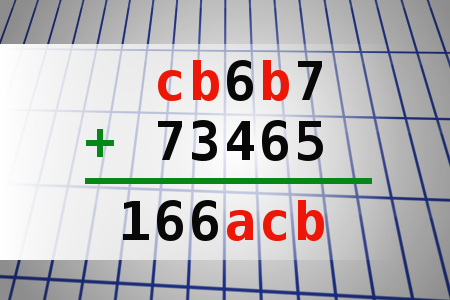
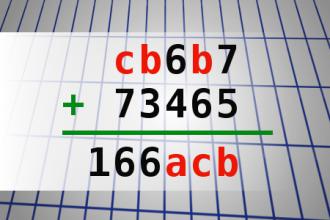
[3225] Find number abc - If cb6b7 + 73465 = 166acb find number abc. Multiple solutions may exist. - #brainteasers #math - Correct Answers: 63 - The first user who solved this task is Allen Wager
BRAIN TEASERS
enter your answer and press button OK

Find number abc

If cb6b7 + 73465 = 166acb find number abc. Multiple solutions may exist.
Correct answers: 63
The first user who solved this task is Allen Wager.
#brainteasers #math
Register with your Google Account and start collecting points.
Check your ranking on list.

The test

Two young engineers applied for a single position at a computer company.

They both had the same qualifications. In order to determine which individual to hire, the applicants were asked to take a test by the Department manager.

Upon completion of the test, both men missed only one of the questions.

The manager went to the first applicant and said, "Thank you for your interest, but we've decided to give the job to the other applicant."

"And why would you be doing that? We both got 9 questions correct," asked the rejected applicant.

"We have based our decision not on the correct answers, but on the question you missed," said the Department manager.

"And just how would one incorrect answer be better than the other?" the rejected applicant inquired.

"Simple," said the Department manager, "Your fellow applicant put down on question #5, 'I don't know.' You put down, 'Neither do I.'"

Jokes of the day - Daily updated jokes. New jokes every day.
Follow Brain Teasers on social networks

Brain Teasers

puzzles, riddles, mathematical problems, mastermind, cinemania...

Charles Frederick Cross

Born 11 Dec 1855; died 15 Apr 1935 at age 79.English chemist who, with Edward Bevan and Clayton Beadle, discovered cellulose could be produced (1891) by the dissolution of cellulose xanthate in dilute sodium hydroxide. Although cellulose had previously been made by others, this type of cellulose is the most popular type in use today. It was a syrupy yellow liquid. In 1892, Cross worked out a method for dissolving cellulose in carbon disulphide (producing a solution he called viscose) which could be squirted out of fine holes. As the solvent evaporated, a fine fibre was formed which became known as viscose rayon (or simply viscose). By 1908, the viscose was also used extruded through a narrow slit to produce thin, transparent sheets of cellophane.
This site uses cookies to store information on your computer. Some are essential to help the site properly. Others give us insight into how the site is used and help us to optimize the user experience. See our privacy policy.