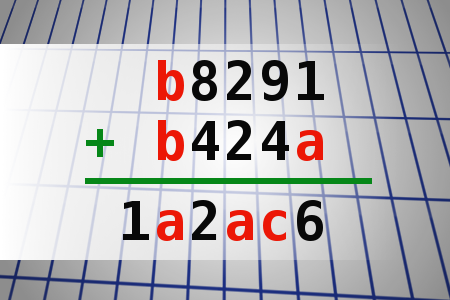
Find number abc
[3518] Find number abc - If b8291 + b424a = 1a2ac6 find number abc. Multiple solutions may exist. - #brainteasers #math - Correct Answers: 66 - The first user who solved this task is Djordje Timotijevic
BRAIN TEASERS
enter your answer and press button OK

Find number abc

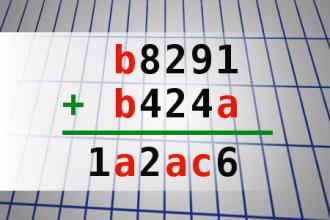
If b8291 + b424a = 1a2ac6 find number abc. Multiple solutions may exist.
Correct answers: 66
The first user who solved this task is Djordje Timotijevic.
#brainteasers #math
Register with your Google Account and start collecting points.
Check your ranking on list.

Jesus Is Watching You!

There was a burglar who broke into a home and started to gather the items he wanted to take. All of a sudden he heard, "Jesus is watching you!" He didn't see anything in the dark house, so he went on with what he was doing.
He heard, "Jesus is watching you!" again and then he really wondered who wassaying that. He turned on the flashlight, scanned the room, and finally saw a parrot.
"Did you say that?" asked the burgler.
"Yes," replied the parrot.
"By the way, what's your name?" the burgler inquired."Moses," answered the parrot.
"That's a strange name for a parrot. Who named you that?"
"The same people who named their rotweiller Jesus!"

Jokes of the day - Daily updated jokes. New jokes every day.
Follow Brain Teasers on social networks

Brain Teasers

puzzles, riddles, mathematical problems, mastermind, cinemania...

Deuterium

In 1933, Ernest Rutherford suggested the names diplogen for the newly discovered heavy hydrogen isotope and diplon for its nucleus. He presented these ideas in the Discussion on Heavy Hydrogen at the Royal Society. For ordinary hydrogen, the lightest of the atoms, having a nuclues of a sole proton, he coined a related name: haplogen. (Greek: haploos, single; diploos, double.) In 1931, Harold Urey had discovered small quantities of atoms of heavy hydrogen wherever ordinary hydrogen occurred. The mass of its nucleus was double that of ordinary hydrogen. This hydrogen-2 is now called deuterium, as named by Urey (Greek: deuteros, second). Its nucleus, named a deuteron, has a neutron in addition to a proton.[ref: Proc. Roy. Soc. A, vol. 144 (1934)]
This site uses cookies to store information on your computer. Some are essential to help the site properly. Others give us insight into how the site is used and help us to optimize the user experience. See our privacy policy.