Find number abc
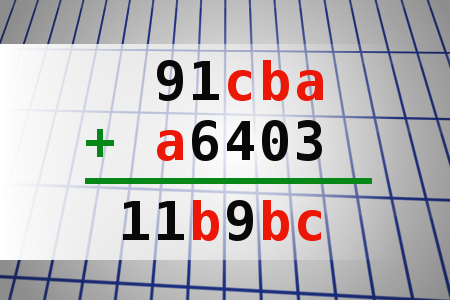
[3557] Find number abc - If 91cba + a6403 = 11b9bc find number abc. Multiple solutions may exist. - #brainteasers #math - Correct Answers: 50 - The first user who solved this task is Linda Tate Young
BRAIN TEASERS
enter your answer and press button OK

Find number abc

If 91cba + a6403 = 11b9bc find number abc. Multiple solutions may exist.
Correct answers: 50
The first user who solved this task is Linda Tate Young.
#brainteasers #math
Register with your Google Account and start collecting points.
Check your ranking on list.

A boy asks his dad...

A boy asks his dad, “What’s the difference between potential and realistic?” The dad tells him to go ask the rest of his family if they’d sleep with Brad Pitt for a million dollars, and then he’d tell him the answer. The boy goes up to his mom and asks her. She responds, “A million dollars is a lot of money sweetheart. I could send you, your sister, and your brother to great colleges, so sure, I would!” He then goes and asks his sister to which she replies, “Brad Pitt? Hell ya, he’s the hottest guy ever!” Next, the boy asks his brother who replies, “A million dollars? Hell yes I would. I’d be rich!” When the boy excitedly returns to his dad with the family’s responses, the dad says, “Well son, potentially, we have three million dollars. Realistically, we have two sluts and a queer.”
Jokes of the day - Daily updated jokes. New jokes every day.
Follow Brain Teasers on social networks

Brain Teasers

puzzles, riddles, mathematical problems, mastermind, cinemania...

John Z. Young

Born 18 Mar 1907; died 4 Jul 1997 at age 90. John Zachary Young was an English zoologist and neuroscientist who had a passionate interest in how animals function, and their brains in particular. His research laid a foundation for modern neurobiology. His career began as a cephalopod biologist, curious also in physiology, experimental psychology and philosophy, but became a neuroscientist. His first paper (1929) was on the previously undescribed epistellar body in the octopus. He continued his research on cephalopods (octopus, squids, cuttlefish and nautiloids) with experiments on octopus learning and the basis of memory. He wrote many more papers on this subject. He identified distinct stores in the octopus brain for visual and touch memories, a brain far more complicated than previously known.«
This site uses cookies to store information on your computer. Some are essential to help the site properly. Others give us insight into how the site is used and help us to optimize the user experience. See our privacy policy.