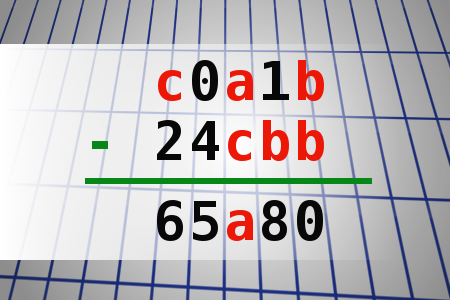
Find number abc
[3918] Find number abc - If c0a1b - 24cbb = 65a80 find number abc. Multiple solutions may exist. - #brainteasers #math - Correct Answers: 45 - The first user who solved this task is Thinh Ddh
BRAIN TEASERS
enter your answer and press button OK

Find number abc

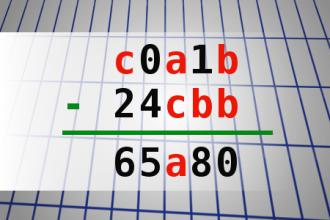
If c0a1b - 24cbb = 65a80 find number abc. Multiple solutions may exist.
Correct answers: 45
The first user who solved this task is Thinh Ddh.
#brainteasers #math

Register with your Google Account and start collecting points.
Check your ranking on list.

A passenger in a taxi leaned o...

A passenger in a taxi leaned over to ask the driver a question and tapped him on the shoulder. The driver screamed, lost control of the cab, nearly hit a bus, drove up over the curb, and stopped just inches from a large plate glass window.

For a few moments everything was silent in the cab, and then the still shaking driver said, "I'm sorry but you scared the daylights out of me."

The frightened passenger apologized to the driver and said he didn't realize a mere tap on the shoulder could frighten him so much.

The driver replied, "No, no, I'm sorry, it's entirely my fault. Today is my first day driving a cab. I've been driving a hearse for the last 25 years."

Jokes of the day - Daily updated jokes. New jokes every day.
Follow Brain Teasers on social networks

Brain Teasers

puzzles, riddles, mathematical problems, mastermind, cinemania...

John Chipman

Died 14 May 1983 at age 86 (born 25 Apr 1897).American physical chemist and metallurgist who researched the role of oxygen in iron and steelmaking. Applying the theories of physical chemistry, he examined the reactions between slag and liquid iron and advanced the techniques of pig iron and steel production. From his work in the early 1930s at the University of Michigan, he began to establish an international reputation for his research on steel. He became a professor of process metallury at M.I.T. in 1937, and was the department head from 1946 until retirement in 1962. During WW II he took a leave of absence from 1943, to work for the Manhattan Project as chief of its metallurgy section, where he found a method to convert powdered unranium into soliod castings, thus providing researchers with a reliable alternate supply of castings when solid uranium was scarce.«
This site uses cookies to store information on your computer. Some are essential to help the site properly. Others give us insight into how the site is used and help us to optimize the user experience. See our privacy policy.