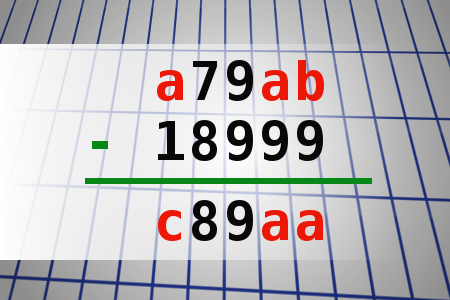
Find number abc
[3926] Find number abc - If a79ab - 18999 = c89aa find number abc. Multiple solutions may exist. - #brainteasers #math - Correct Answers: 40 - The first user who solved this task is Thinh Ddh
BRAIN TEASERS
enter your answer and press button OK

Find number abc

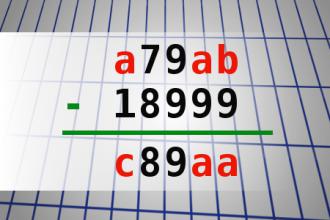
If a79ab - 18999 = c89aa find number abc. Multiple solutions may exist.
Correct answers: 40
The first user who solved this task is Thinh Ddh.
#brainteasers #math
Register with your Google Account and start collecting points.
Check your ranking on list.

Selection of recent Dad jokes and puns

When does a sandwich cook?
When it is bakin' lettuce and tomato.

Why did the smart phone need glasses?
It lost all its contacts.

What state has the smallest drinks?
Mini-soda.

Why did the cow cross the road?
They wanted to go to the mooooovies.

What do you call a funky car?
Mustang.

What did the hammer say to his homeboys?
Nailed it.

Why are cats good at video games?
Because they have nine lives.

What do you call a deer with no eyes?
No idea.

What is big and green and falls off over the tree will kill you?
A snooker table.

What did the French guy do when he drank too much water?
He went oui oui in his pants.

Where do pencils spend their vacation?
Pencil-Vania.

What do flies eat for breakfast?
A bowl of poop loops.

Why did the balloon go near the needle?
He wanted to be a pop star.

What did the duck do when he read all these jokes?
He quacked up.

Why was the tomato all red?
It saw the salad dressing.

What do you call a female magician in the dessert?
A sand witch.

How do billboards talk?
Sign language.

I hurt my foot driving the other day. You know what I called?
The toe company.

What does a dinosaur use to pay bills?
Tyrannosaurus checks.

Jokes of the day - Daily updated jokes. New jokes every day.
Follow Brain Teasers on social networks

Brain Teasers

puzzles, riddles, mathematical problems, mastermind, cinemania...

Sir William Cecil Dampier

Born 27 Dec 1867; died 11 Dec 1952 at age 84. British scientist, agriculturist, and science historian who developed a method of extracting lactose (milk sugar) from the surplus whey. His invention, which was later put to use on a commercial scale, was prompted by the cheese shortage in Britain during WW I. From 1917, he conducted experiments for more efficient means of production on farm land with an estate inherited from one of his uncles. He was instrumental in the formation of the Agricultural Research Council, serving as its first secretary (1931-35). In A History of Science and Its Relations with Philosophy and Religion, he surveyed scientific breakthroughs from ancient Babylonia and Egypt, through to the early twentieth century. He was knighted (1931) for public service in agriculture.«
This site uses cookies to store information on your computer. Some are essential to help the site properly. Others give us insight into how the site is used and help us to optimize the user experience. See our privacy policy.