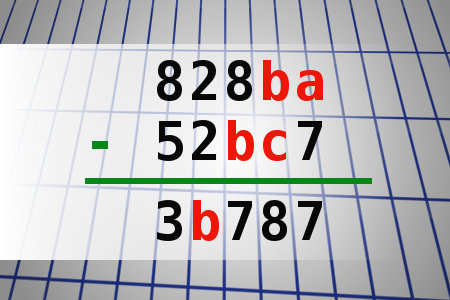
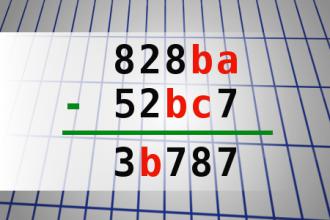
Find number abc
[4063] Find number abc - If 828ba - 52bc7 = 3b787 find number abc. Multiple solutions may exist. - #brainteasers #math - Correct Answers: 47 - The first user who solved this task is Djordje Timotijevic
BRAIN TEASERS
enter your answer and press button OK

Find number abc

If 828ba - 52bc7 = 3b787 find number abc. Multiple solutions may exist.
Correct answers: 47
The first user who solved this task is Djordje Timotijevic.
#brainteasers #math
Register with your Google Account and start collecting points.
Check your ranking on list.

John Smith started the day ear...

John Smith started the day early, having set his alarm clock (MADE IN JAPAN) for 6 am.

While his coffeepot (MADE IN CHINA) was perking, he shaved with his electric razor (MADE IN HONG KONG), and put on a dress shirt (MADE IN SRI LANKA), designer jeans (MADE IN SINGAPORE) and tennis shoes (MADE IN KOREA).

After cooking his breakfast in his new electric skillet (MADE IN INDIA), he sat down with his calculator (MADE IN MEXICO), to see how much he could spend today.

After setting his watch (MADE IN TAIWAN) to the radio (MADE IN INDIA), he got in his car (MADE IN JAPAN), filled it with GAS (from SAUDI ARABIA) to continued his search for a good paying AMERICAN JOB.

At the end of yet another discouraging and fruitless day checking his Computer (made in MALAYSIA), John decided to relax for a while.

He put on his sandals (MADE IN BRAZIL), poured himself a glass of wine (MADE IN FRANCE) and turned on his TV (MADE IN INDONESIA)...
And then wondered why he can't find a good paying job in AMERICA.

And now he is hoping he can get help from the president (MADE IN KENYA)?
Jokes of the day - Daily updated jokes. New jokes every day.
Follow Brain Teasers on social networks

Brain Teasers

puzzles, riddles, mathematical problems, mastermind, cinemania...

Sir D'Arcy Wentworth Thompson

Born 2 May 1860; died 21 Jun 1948 at age 88.Scottish zoologist and classical scholar, who is noted for his influential workOn Growth and Form (1917, new ed. 1942). It is a profound consideration of the shapes of living things, starting from the simple premise that “everything is the way it is because it got that way.”Hence one must study not only finished forms, but also the forces that moulded them: “the form of an object is a ‘diagram of forces’, in this sense, at least, that from it we can judge of or deduce the forces that are acting or have acted upon it.”' One of his great themes is the tremendous light cast on living things by using mathematics to describe their shapes and fairly simple physics and chemistry to explain them..
This site uses cookies to store information on your computer. Some are essential to help the site properly. Others give us insight into how the site is used and help us to optimize the user experience. See our privacy policy.