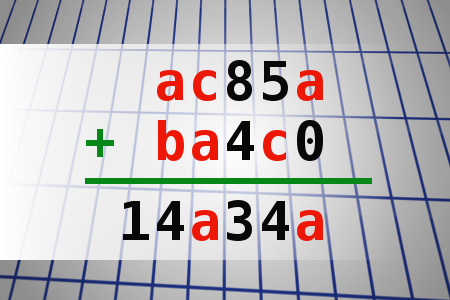
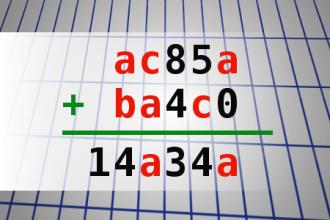
Find number abc
[4232] Find number abc - If ac85a + ba4c0 = 14a34a find number abc. Multiple solutions may exist. - #brainteasers #math - Correct Answers: 54 - The first user who solved this task is Djordje Timotijevic
BRAIN TEASERS
enter your answer and press button OK

Find number abc

If ac85a + ba4c0 = 14a34a find number abc. Multiple solutions may exist.
Correct answers: 54
The first user who solved this task is Djordje Timotijevic.
#brainteasers #math
Register with your Google Account and start collecting points.
Check your ranking on list.

Buy Machine Factory

An American manufacturer is showing his machine factory to a potential customer from Albania. At noon, when the lunch whistle blows, two thousand men and women immediately stop work and leave the building.
"Your workers, they're escaping!" cries the visitor. "You've got to stop them."
"Don't worry, they'll be back," says the American. And indeed, at exactly one o'clock the whistle blows again, and all the workers return from their break.
When the tour is over, the manufacturer turns to his guest and says, "Well, now, which of these machines would you like to order?"
"Forget the machines," says the visitor. "How much do you want for that whistle?"
Jokes of the day - Daily updated jokes. New jokes every day.
Follow Brain Teasers on social networks

Brain Teasers

puzzles, riddles, mathematical problems, mastermind, cinemania...

Neil Bartlett

Died 5 Aug 2008 at age 75 (born 15 Sep 1932).English-American chemist who formed the first compound with a noble gas element, xenon platinofluoride, XePtF6 (23 Mar 1962), a yellow-orange crystalline solid, stable at room temperature by immersing platinum fluoride in xenon gas. For a half-century since Ramsay discovered xenon, it had, with the other elements in its group on the Periodic Table, been known as an inert gas. After Bartlett's discovery, a new field of investigation was opened, and other chemists found further compounds of not only xenon, but the noble gas elements radon and krypton. The heaviest elements of the noble gases, as the least inert, were susceptible to combination with a highly reactive element. Pauling had proposed this in theoretical calculations made thirty years before Bartlett's experimental success.«
This site uses cookies to store information on your computer. Some are essential to help the site properly. Others give us insight into how the site is used and help us to optimize the user experience. See our privacy policy.