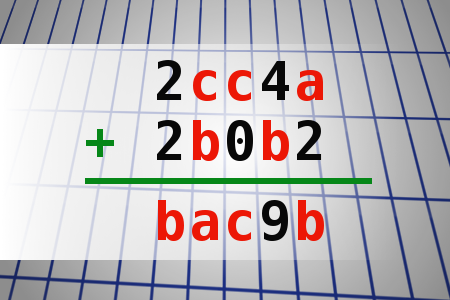
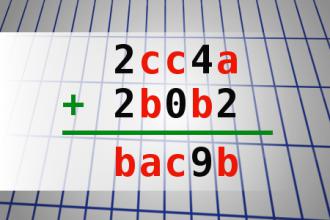
Find number abc
[4444] Find number abc - If 2cc4a + 2b0b2 = bac9b find number abc. Multiple solutions may exist. - #brainteasers #math - Correct Answers: 35 - The first user who solved this task is Thinh Ddh
BRAIN TEASERS
enter your answer and press button OK

Find number abc

If 2cc4a + 2b0b2 = bac9b find number abc. Multiple solutions may exist.
Correct answers: 35
The first user who solved this task is Thinh Ddh.
#brainteasers #math
Register with your Google Account and start collecting points.
Check your ranking on list.

Software Development Cycles

Software Development Cycles
1. Programmer produces code he believes is bug-free.
2. Product is tested. 20 bugs are found.
3. Programmer fixes 10 of the bugs and explains to the testing department that the other 10 aren’t really bugs.
4. Testing department finds that five of the fixes didn’t work and discovers 15 new bugs.
5. Repeat three times steps 3 and 4.
6. Due to marketing pressure and an extremely premature product announcement based on overly-optimistic programming schedule, the product is released.
7. Users find 137 new bugs.
8. Original programmer, having cashed his royalty check, is nowhere to be found.
9. Newly-assembled programming team fixes almost all of the 137 bugs, but introduce 456 new ones.
10. Original programmer sends underpaid testing department a postcard from Fiji. Entire testing department quits.
11. Company is bought in a hostile takeover by competitor using profits from their latest release, which had 783 bugs.
12. New CEO is brought in by board of directors. He hires a programmer to redo program from scratch.
13. Programmer produces code he believes is bug-free…
Jokes of the day - Daily updated jokes. New jokes every day.
Follow Brain Teasers on social networks

Brain Teasers

puzzles, riddles, mathematical problems, mastermind, cinemania...

Cotton cultivator

In 1874, an “Improvement in Cotton-Cultivators” was issued a U.S. patent for its black American inventor, Edward H. Sutton, of Edenton, north Carolina (No. 149,543). A horizontal beam, mounted on wheels, had a harness coupling at the front, and carried three blades. Teeth on the forward blade were intended to loosen and pulverise the soil, followed by two blades to cut weeds. The middle of the three blades was arranged to “be rotated in such a manner as to cut the weeds or thin out the growing cotton which is beyond the reach of the stationary blade” at the back. Adjustment of the middle blade was made using a spring-loaded lever attached from to one of the operator's handles behind the plough. The short patent application was made on 10 Feb 1874, and issued less than two months later.«[Image: detail from patent drawing, showing blades.]
This site uses cookies to store information on your computer. Some are essential to help the site properly. Others give us insight into how the site is used and help us to optimize the user experience. See our privacy policy.