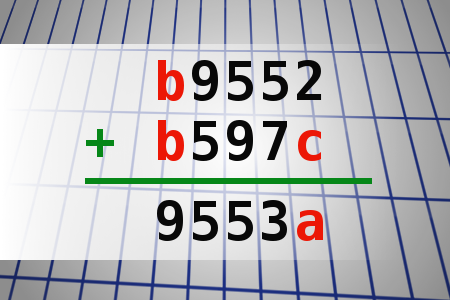
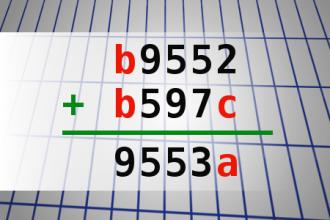
Find number abc
[4789] Find number abc - If b9552 + b597c = 9553a find number abc. Multiple solutions may exist. - #brainteasers #math - Correct Answers: 61 - The first user who solved this task is Djordje Timotijevic
BRAIN TEASERS
enter your answer and press button OK

Find number abc

If b9552 + b597c = 9553a find number abc. Multiple solutions may exist.
Correct answers: 61
The first user who solved this task is Djordje Timotijevic.
#brainteasers #math
Register with your Google Account and start collecting points.
Check your ranking on list.

Fish Heads

A customer at Green's Gourmet Grocery marveled at the proprietor's quick wit and intelligence.
"Tell me, Green, what makes you so smart?"
"I wouldn't share my secret with just anyone," Green replies, lowering his voice so the other shoppers won't hear. "But since you're a good and faithful customer, I'll let you in on it. Fish heads. You eat enough of them, you'll be positively brilliant."
"You sell them here?" the customer asks.
"Only $4 apiece," says Green.
The customer buys three. A week later, he's back in the store complaining that the fish heads were disgusting and he isn't any smarter.
"You didn't eat enough, " says Green. The customer goes home with 20 more fish heads. Two weeks later, he's back and this time he's really angry.
"Hey, Green," he says, "You're selling me fish heads for $4 apiece when I can buy the whole fish for $2. You're ripping me off!"

"You see?" says Green. "You're getting smarter already!"

Jokes of the day - Daily updated jokes. New jokes every day.
Follow Brain Teasers on social networks

Brain Teasers

puzzles, riddles, mathematical problems, mastermind, cinemania...

Philip W. Anderson

Born 13 Dec 1923. Philip Warren Anderson is an American physicist who shared (with John H. Van Vleck and Sir Nevill F. Mott)the 1977 Nobel Prize for Physics for his research on semiconductors, superconductivity, and magnetism. He made contributions to the study of solid-state physics, and research on molecular interactions has been facilitated by his work on the spectroscopy of gases. He conceived a model (known as the Anderson model) to describe what happens when an impurity atom is present in a metal. He also investigated magnetism and superconductivity, and his work is of fundamental importance for modern solid-state electronics, making possible the development of inexpensive electronic switching and memory devices in computers.
This site uses cookies to store information on your computer. Some are essential to help the site properly. Others give us insight into how the site is used and help us to optimize the user experience. See our privacy policy.