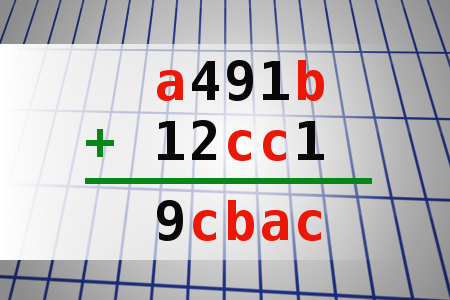
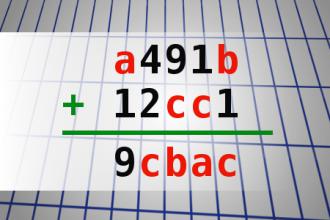
Find number abc
[4947] Find number abc - If a491b + 12cc1 = 9cbac find number abc. Multiple solutions may exist. - #brainteasers #math - Correct Answers: 37 - The first user who solved this task is Djordje Timotijevic
BRAIN TEASERS
enter your answer and press button OK

Find number abc

If a491b + 12cc1 = 9cbac find number abc. Multiple solutions may exist.
Correct answers: 37
The first user who solved this task is Djordje Timotijevic.
#brainteasers #math
Register with your Google Account and start collecting points.
Check your ranking on list.

Upon reaching 65, old Tom deci...

Upon reaching 65, old Tom decided to retire. His wife suggested he go and do something to occupy his time, like join a club or get a hobby
Old Tom obliged and went out for a couple of hours. When he got home his wife asked about his day and he replied, "Oh, I joined a parachute club."
"What? Are you nuts? You're 65 years old and you're going to start jumping out of airplanes?"
"Yeah, look I even got a membership card."
"Old man, you need glasses! This is a membership in a Prostitute Club, not a Parachute Club!"
"Oh, great! Now what am I going to do? I signed up for 5 jumps a week!"
Jokes of the day - Daily updated jokes. New jokes every day.
Follow Brain Teasers on social networks

Brain Teasers

puzzles, riddles, mathematical problems, mastermind, cinemania...

Early printed mathematical tables

In 1483, Tabulae Alphonsinae (“Alphonsine Tables”) was published by German printer Erhard Ratdolt in Venice. The Alphonsine Tables were among the earliest mathematical tables to be printed. They were calculated from 1262 to 1272 by about 50 astronomers, human computers, at Toledo, Spain. The tables were compiled at the behest of King Alfonso X of Castile and León. They were based on Latin translations of the Tables of the Cordoban by the 11th-century mathematician and astronomer Abū Ishāq Ibrāhīm al-Zarqālī (also known as Arzachel), who lived in Toledo, Castile, Al-Andalus (now Spain). His original Spanish text no longer existed. The new versions of the tables were revised and improved, from the later Latin versions, yet still applying the Ptolemaic description of celestial motion.«
This site uses cookies to store information on your computer. Some are essential to help the site properly. Others give us insight into how the site is used and help us to optimize the user experience. See our privacy policy.