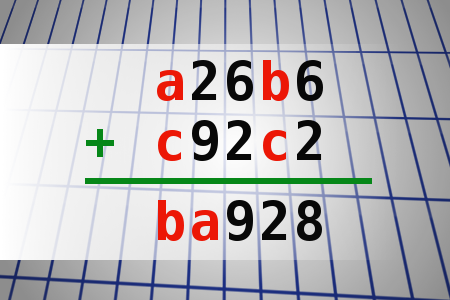
Find number abc
[5080] Find number abc - If a26b6 + c92c2 = ba928 find number abc. Multiple solutions may exist. - #brainteasers #math - Correct Answers: 58 - The first user who solved this task is Djordje Timotijevic
BRAIN TEASERS
enter your answer and press button OK

Find number abc

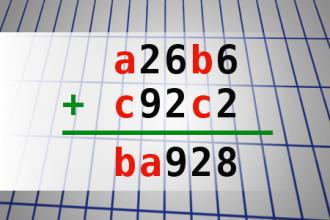
If a26b6 + c92c2 = ba928 find number abc. Multiple solutions may exist.
Correct answers: 58
The first user who solved this task is Djordje Timotijevic.
#brainteasers #math
Register with your Google Account and start collecting points.
Check your ranking on list.

Negotiations between union mem...

Negotiations between union members and their employer were at an impasse. The union denied that their workers were flagrantly abusing the sick-leave provisions set out by their contract.
One morning at the bargaining table, the company's chief negotiator held aloft the morning edition of the newspaper, "This man," he announced, "called in sick yesterday!"
There on the sports page, was a photo of the supposedly ill employee, who had just won a local golf tournament with an excellent score.
A union negotiator broke the silence in the room.
"Wow!" he said. "Just think of the score he could have had if he wasn't sick!"
Jokes of the day - Daily updated jokes. New jokes every day.
Follow Brain Teasers on social networks

Brain Teasers

puzzles, riddles, mathematical problems, mastermind, cinemania...

Richard Hamming

Died 7 Jan 1998 at age 82 (born 11 Feb 1915). Richard Wesley Hamming was an American computer scientist and mathematician whodevisedcomputer Hamming codes - error-detecting and correcting codes (1947). These add one or more bits to the transmission of blocks of data, used for a parity check, so that errors can be corrected automatically. By making a resend of bad data unnecessary, efficiency improved for modems, compact disks and satellite communications. He also worked on programming languages, numerical analysis and the Hamming spectral window (used to smooth data before Fourier analysis is carried out). He taught at University of Louisville, then during WW II worked (1945) on computers with the Manhattan Project creating the atomic bomb. From 1946, he spent 30 years with Bell Telephone Labs, eventually becoming head of computing science research.«
This site uses cookies to store information on your computer. Some are essential to help the site properly. Others give us insight into how the site is used and help us to optimize the user experience. See our privacy policy.