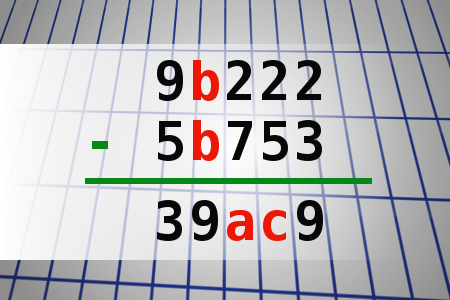
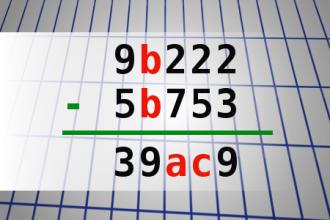
Find number abc
[5774] Find number abc - If 9b222 - 5b753 = 39ac9 find number abc. Multiple solutions may exist. - #brainteasers #math - Correct Answers: 41 - The first user who solved this task is Nílton Corrêa De Sousa
BRAIN TEASERS
enter your answer and press button OK

Find number abc

If 9b222 - 5b753 = 39ac9 find number abc. Multiple solutions may exist.
Correct answers: 41
The first user who solved this task is Nílton Corrêa De Sousa.
#brainteasers #math
Register with your Google Account and start collecting points.
Check your ranking on list.

Cork Screw

Gary and Martin were standing at the urinals in a public lavatory, when Gary glanced over and noticed that Martin's penis was twisted like a corkscrew. "Wow," Gary said. "I've never seen one like that before."
"Like what?" Martin said.
"All twisted like a pig's tail," Gary said.
"Well, what's yours like?" Martin said.
"Straight, like normal," Gary said.
"I thought mine was normal until I saw yours," Martin said.
Gary finished what he was doing and started to give his old boy a shakedown prior to putting it back in his pants. "What did you do that for?" Martin said.
"Shaking off the excess drops," Gary said. "Like normal."
"&%$#@ !," Martin said. "And all these years I've been wringing it."

Jokes of the day - Daily updated jokes. New jokes every day.
Follow Brain Teasers on social networks

Brain Teasers

puzzles, riddles, mathematical problems, mastermind, cinemania...

Albert Sauveur

Born 21 Jun 1863; died 26 Jan 1939 at age 75.Belgian-born American metallurgist whose microscopic and photomicroscopic studies of metal structures make him one of the founders of physical metallurgy. In 1891 he began working with the South Chicago works of the Illinois Steel Company where, to follow his ideas, he was provided with a microscope and a room to work in. "This small beginning," Sauveur later wrote, "marked the introduction of metallography into the iron and steel industry of the United States." He is best known for his research on the hardening of steel (1893) that "the properties of steel rails were largely dependent on the dimensions of their microscopical constituents or grain sizes, and that in turn these dimensions resulted chiefly from the finishing temperatures."
This site uses cookies to store information on your computer. Some are essential to help the site properly. Others give us insight into how the site is used and help us to optimize the user experience. See our privacy policy.