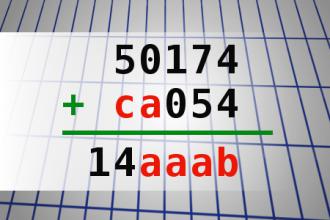
Find number abc
[5872] Find number abc - If 50174 + ca054 = 14aaab find number abc. Multiple solutions may exist. - #brainteasers #math - Correct Answers: 35 - The first user who solved this task is Nílton Corrêa De Sousa
BRAIN TEASERS
enter your answer and press button OK

Find number abc

If 50174 + ca054 = 14aaab find number abc. Multiple solutions may exist.
Correct answers: 35
The first user who solved this task is Nílton Corrêa De Sousa.
#brainteasers #math
Register with your Google Account and start collecting points.
Check your ranking on list.

Ever go fishing?

A man was speeding down the highway, feeling secure in a gaggle of cars all traveling at the same speed. However, as they passed a speed trap, he got nailed with an infrared speed detector and was pulled over.

The officer handed him the citation, received his signature and was about to walk away when the man asked, "Officer, I know I was speeding, but I don't think it's fair - there were plenty of other cars around me who were going just as fast, so why did *I* get the ticket?"

"Ever go fishing?" the policeman suddenly asked the man.

"Ummm, yeah..." the startled man replied.

The officer grinned and added, "Ever catch *all* the fish?"

Jokes of the day - Daily updated jokes. New jokes every day.
Follow Brain Teasers on social networks

Brain Teasers

puzzles, riddles, mathematical problems, mastermind, cinemania...

Teflon

In 1938, Du Pont researcher Roy J. Plunkett and his technician Jack Rebok accidentally discovered the chemical compound polytetrafluoroethylene (PTFE), later marketed as Teflon. Plunkett was researching chemical reactions of the gas perfluoroethylene in order to synthesize new types of refrigerant gases. Rebok found an apparently defective cylinder of this gas, since no pressure was found when the valve was opened, even though the cylinder weight was the same as full cylinders. Rebok suggested sawing it open to investigate. Inside was a slippery white powder. Plunkett found it had unusual properties, a wonderful solid lubricant in powdered form, was chemically inert and had a very high melting point. He realized it was formed by an unexpected polymerization. It was patented on 4 Feb 1941.
This site uses cookies to store information on your computer. Some are essential to help the site properly. Others give us insight into how the site is used and help us to optimize the user experience. See our privacy policy.