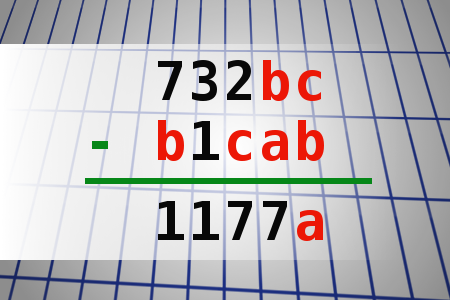
Find number abc
[6553] Find number abc - If 732bc - b1cab = 1177a find number abc. Multiple solutions may exist. - #brainteasers #math - Correct Answers: 18 - The first user who solved this task is Nasrin 24 T
BRAIN TEASERS
enter your answer and press button OK

Find number abc

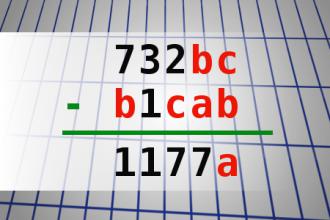
If 732bc - b1cab = 1177a find number abc. Multiple solutions may exist.
Correct answers: 18
The first user who solved this task is Nasrin 24 T.
#brainteasers #math
Register with your Google Account and start collecting points.
Check your ranking on list.

Life has thrown so much at you

Breathe. All of the times you felt this anxious and this overwhelmed. All of the times you felt this level of pain. And remind yourself how each time, you made it through. Life has thrown so much at you, and despite how difficult things have been, you’ve survived. Breathe and trust that you can survive this too. Trust that this struggle is part of the process. And trust that as long as you don’t give up and keep pushing forward, no matter how hopeless things seem, you will make it.
Jokes of the day - Daily updated jokes. New jokes every day.
Follow Brain Teasers on social networks

Brain Teasers

puzzles, riddles, mathematical problems, mastermind, cinemania...

Averroes

Died 10 Dec 1198 (born 1126). Abu-alWalid Muhammad Ibn Ahmad Ibn (known as Averroes) was a Spanish philosopher, physician and astronomer who is known for his Kulliyat fi ab tb (Generalities on Medicine) produced between 1162-69 on topics ranging from organ anatomy and hygiene to the prevention, diagnosis, and treatment of diseases. In this work, which spread widely in translations, he attempted to logically codify the existing medical knowledge. He critized adherance to tradition and instead stressed the importance of empirical evidence. In astronomy, he believed that the motion of the planets had to be around a physical centre (the Earth) and rejected Ptolemy's system of epicycles. He was the most famous of the medieval Islamic philosophers and as a principal interpreter of Aristotle, his commentaries were widely used as standard texts until the sixteenth century.«[Image: Ibn Rushd as portrayed in a detail from Raffaello Sanzio's fresco, The School of Athens (1509).]
This site uses cookies to store information on your computer. Some are essential to help the site properly. Others give us insight into how the site is used and help us to optimize the user experience. See our privacy policy.