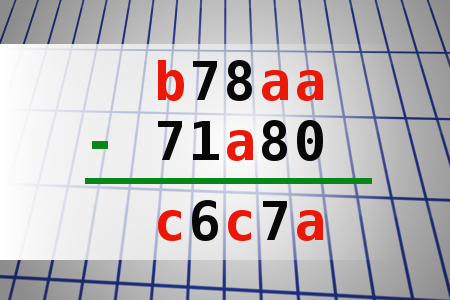
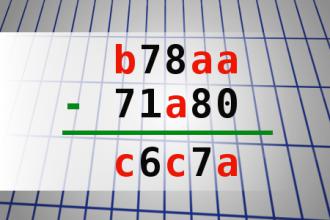
Find number abc
[6565] Find number abc - If b78aa - 71a80 = c6c7a find number abc. Multiple solutions may exist. - #brainteasers #math - Correct Answers: 24 - The first user who solved this task is Nasrin 24 T
BRAIN TEASERS
enter your answer and press button OK

Find number abc

If b78aa - 71a80 = c6c7a find number abc. Multiple solutions may exist.
Correct answers: 24
The first user who solved this task is Nasrin 24 T.
#brainteasers #math
Register with your Google Account and start collecting points.
Check your ranking on list.

How You Made Money

A young man asked an old rich man how he made his money.
The old guy fingered his worsted wool vest and said, "Well, son, it was 1932. The depth of the Great Depression. I was down to my last nickel.
"I invested that nickel in an apple. I spent the entire day polishing the apple and, at the end of the day, I sold the apple for ten cents.
"The next morning, I invested those ten cents in two apples. I spent the entire day polishing them and sold them at 5:00 pm for 20 cents. I continued this system for a month, by the end of which I'd accumulated a fortune of $1.37."
"And that's how you built an empire?" the boy asked.
"Heavens, no!" the man replied. "Then my wife's father died and left us two million dollars."
Jokes of the day - Daily updated jokes. New jokes every day.
Follow Brain Teasers on social networks

Brain Teasers

puzzles, riddles, mathematical problems, mastermind, cinemania...

Deuterium

In 1933, Ernest Rutherford suggested the names diplogen for the newly discovered heavy hydrogen isotope and diplon for its nucleus. He presented these ideas in the Discussion on Heavy Hydrogen at the Royal Society. For ordinary hydrogen, the lightest of the atoms, having a nuclues of a sole proton, he coined a related name: haplogen. (Greek: haploos, single; diploos, double.) In 1931, Harold Urey had discovered small quantities of atoms of heavy hydrogen wherever ordinary hydrogen occurred. The mass of its nucleus was double that of ordinary hydrogen. This hydrogen-2 is now called deuterium, as named by Urey (Greek: deuteros, second). Its nucleus, named a deuteron, has a neutron in addition to a proton.[ref: Proc. Roy. Soc. A, vol. 144 (1934)]
This site uses cookies to store information on your computer. Some are essential to help the site properly. Others give us insight into how the site is used and help us to optimize the user experience. See our privacy policy.