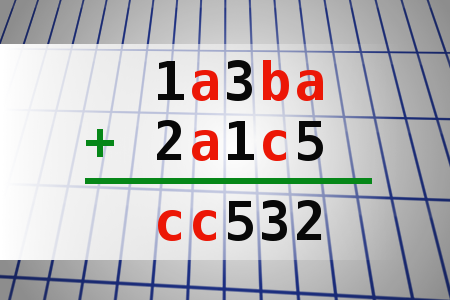
Find number abc
[6697] Find number abc - If 1a3ba + 2a1c5 = cc532 find number abc. Multiple solutions may exist. - #brainteasers #math - Correct Answers: 19 - The first user who solved this task is Nasrin 24 T
BRAIN TEASERS
enter your answer and press button OK

Find number abc

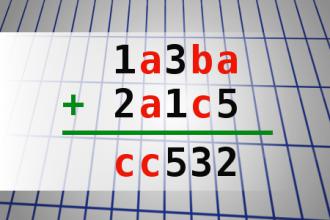
If 1a3ba + 2a1c5 = cc532 find number abc. Multiple solutions may exist.
Correct answers: 19
The first user who solved this task is Nasrin 24 T.
#brainteasers #math
Register with your Google Account and start collecting points.
Check your ranking on list.

Why English Is Tough

Twenty-one reasons why English is hard to learn.
1. The bandage was wound around the wound.
2. The farm was used to produce produce.
3. The dump was so full it had to refuse more refuse.
4. We must polish the Polish furniture.
5. He could lead if he would get the lead out.
6. The soldier decided to desert his dessert in the desert.
7. Since there was no time like the present, he thought it was time to present the present.
8. A bass was painted on the head of the bass drum.
9. When shot at, the dove dove into the bushes.
10. I did not object to the object.
11. The insurance was invalid for the invalid.
12. There was a row among the oarsmen on how to row.
13. They were too close to the door to close it.
14. The buck does funny things when does are present.
15. A seamstress and a sewer fell down into a sewer line.
16. To help with planting, the farmer taught his sow to sow.
17. The wind was too strong to wind the sail.
18. After a number of injections my jaw got number.
19. Upon seeing the tear in the painting I shed a tear.
20. I had to subject the subject to a series of tests.
21. How can I intimate this to my most intimate friend?
Jokes of the day - Daily updated jokes. New jokes every day.
Follow Brain Teasers on social networks

Brain Teasers

puzzles, riddles, mathematical problems, mastermind, cinemania...

George Wallace Kidder

Born 9 Dec 1902; died 1996 .American biochemist who demonstrated that a chemical distinction exists between tumorous and normal cells. He was a protozoologist for a number of years in his early career. His study of tetrahymena, a one-cell, pond ciliate with a basic biochemical pattern in most respects resembling that of human cells, led to his discoveries in abnormal growths and, ultimately, in cancerous cells. In spring of 1949, Kidder and his associates discovered that azaguanine, a metabolic analog of guanine, would inhibit the growth of certain forms of cancer and leukemia in mice without injuring the normal cells of the host. (Subsequently, other researchers found to be unsuccessful in cancer treatment of humans, even toxic.)
This site uses cookies to store information on your computer. Some are essential to help the site properly. Others give us insight into how the site is used and help us to optimize the user experience. See our privacy policy.