Find number abc
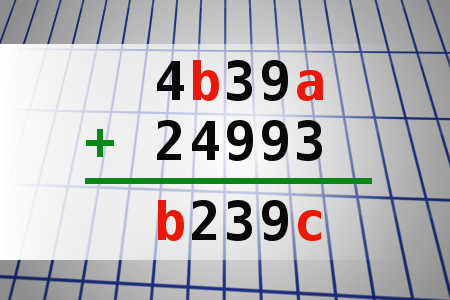
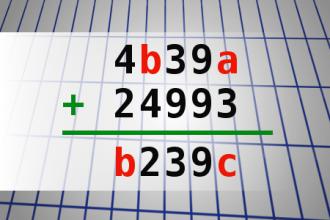
[6724] Find number abc - If 4b39a + 24993 = b239c find number abc. Multiple solutions may exist. - #brainteasers #math - Correct Answers: 39 - The first user who solved this task is Nasrin 24 T
BRAIN TEASERS
enter your answer and press button OK

Find number abc

If 4b39a + 24993 = b239c find number abc. Multiple solutions may exist.
Correct answers: 39
The first user who solved this task is Nasrin 24 T.
#brainteasers #math
Register with your Google Account and start collecting points.
Check your ranking on list.

Question and answer blond jokes

Q: Why don't blondes call 911 in an emergency?

A: They can't remember the number.

Q: Why don't blondes call 911 in an emergency?

A: She can't find the number 11 on the telephone buttons.

Q: How many blondes does it take to change a lightbulb?

A: "What's a lightbulb?"

Q: How many blondes does it take to change a lightbulb?

A: Two. One to hold the Diet Pepsi, and one to call, "Daaady!"

Q: How do you get rid of blondes?

A: Form a circle, give each blonde a gun, and tell them they are a firing squad.

Q: Santa Claus, the Tooth Fairy, a dumb blonde, and a smart blonde are walking down the street when they spot a $10bill. Who picks it up?

A: The dumb blonde! because, there is no such thing as Santa Claus, the tooth fairy, or a smart blonde.

Q: Santa Claus, the Tooth Fairy, a dumb blonde, and a smart blonde are walking down the street when they spot a $10bill. Who picks it up?

A: None of them, two don't exist and the dumb blonde thought it was a gum wrapper.

Jokes of the day - Daily updated jokes. New jokes every day.
Follow Brain Teasers on social networks

Brain Teasers

puzzles, riddles, mathematical problems, mastermind, cinemania...

Paul Gottlieb Nipkow

Died 24 Aug 1940 at age 80 (born 22 Aug 1860).German engineer who discovered television's scanning principle, in which the light intensities of small portions of an image are successively analyzed and transmitted. Nipkow's invented (1884) a rotating disk (Nipkow disk) with one or more spirals of apertures that passed successively across the picture to make a mechanically scanned television system.
This site uses cookies to store information on your computer. Some are essential to help the site properly. Others give us insight into how the site is used and help us to optimize the user experience. See our privacy policy.