Find number abc
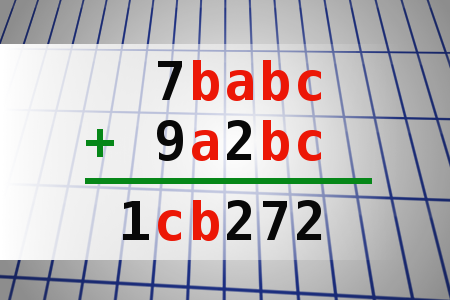
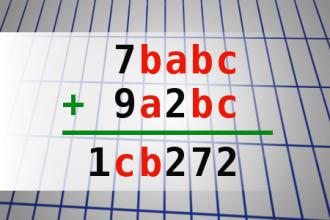
[6731] Find number abc - If 7babc + 9a2bc = 1cb272 find number abc. Multiple solutions may exist. - #brainteasers #math - Correct Answers: 22 - The first user who solved this task is Nasrin 24 T
BRAIN TEASERS
enter your answer and press button OK

Find number abc

If 7babc + 9a2bc = 1cb272 find number abc. Multiple solutions may exist.
Correct answers: 22
The first user who solved this task is Nasrin 24 T.
#brainteasers #math
Register with your Google Account and start collecting points.
Check your ranking on list.

The Pickle

There was a guy on the beach with about 25 gorgeous chicks swarming all around him.
Seeing this, a second guy strolls on up to him and asks, "What's your secret?"
The guy whispers, "All you gotta do is stick a pickle in your pants."
In a fluorish, the second guy runs off and stuffs a pickle in his pants. But when he returns to the shore, he soon discovers that every single girl that looks his way, runs off screaming in bloody terror. Confused, he hurries over to the first guyand desperately asks, "Why are all the girls running away from me?"
The first guy looks up and replies, "The pickle's on the wrong side."

Jokes of the day - Daily updated jokes. New jokes every day.
Follow Brain Teasers on social networks

Brain Teasers

puzzles, riddles, mathematical problems, mastermind, cinemania...

James Bryan Herrick

Born 11 Aug 1861; died 7 Mar 1954 at age 92.American physician and clinical cardiologist who was the first to observe and describe sickle-cell anemia. In 1910, he reported an unusual case he had examined. The patient was a 20-year-old West Indies student, attending a dental school in Chicago. "His illness had begun with malaise, pain in the back, the muscles of the legs and arms. He had a slight fever and was pale... he had suffered from a bilious attack... had vomited and... somewhat short of breath." In a blood test, Herrick found "nucleated reds were numerous [normal red blood cells lack a nucleus], 74 being seen in a count of 200 leukocytes [white blood cells]. The shape of the reds was very irregular... [with a] large number of thin, elongated, sickle-shaped and crescent-shaped forms."
This site uses cookies to store information on your computer. Some are essential to help the site properly. Others give us insight into how the site is used and help us to optimize the user experience. See our privacy policy.