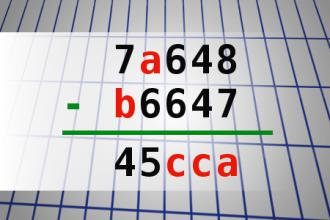
Find number abc
[6738] Find number abc - If 7a648 - b6647 = 45cca find number abc. Multiple solutions may exist. - #brainteasers #math - Correct Answers: 29 - The first user who solved this task is Nasrin 24 T
BRAIN TEASERS
enter your answer and press button OK

Find number abc

If 7a648 - b6647 = 45cca find number abc. Multiple solutions may exist.
Correct answers: 29
The first user who solved this task is Nasrin 24 T.
#brainteasers #math
Register with your Google Account and start collecting points.
Check your ranking on list.

Tetanus Shot

The old man in his mid-eighties struggles to get up from the couch then starts putting on his coat.
His wife, seeing the unexpected behavior, asks, "Where are you going?"
He replies, "I'm going to the doctor."
She says, "Why, are you sick?"
He says, "Nope, I'm going to get me some of that Viagra stuff."
Immediately the wife starts working and positioning herself to get out of her rocker and begins to put on her coat.
He says, "Where the hell are you going"?
She answers, "I'm going to the doctor, too."
He says, "Why, what do you need?"
She says, "If you're going to start using that rusty old thing, I'm getting a tetanus shot."

Jokes of the day - Daily updated jokes. New jokes every day.
Follow Brain Teasers on social networks

Brain Teasers

puzzles, riddles, mathematical problems, mastermind, cinemania...

Walter Bradford Cannon

Born 19 Oct 1871; died 1 Oct 1945 at age 73. American physiologist and neurologist who was the first to use X-rays in physiological studies. These led to his publication of The Mechanical Factors of Digestion (1911). He investigated hemorrhagic and traumatic shock during WW I. He devised the term homeostasis (1930) for how the body maintains its temperature. He worked on methods of blood storage and discovered sympathin (1931), an adrenaline-like substance that is liberated at the tips of certain nerve cells. He died from leukemia - probably a legacy from his early work with X rays. He was nominated for a Nobel Prize in 1920 for his work on digestion, but his claim was ruled out as "too old." In 1934, 1935, and 1936 he was adjudged “prizeworthy” by the appropriate Nobel jurors but was not given a prize.
This site uses cookies to store information on your computer. Some are essential to help the site properly. Others give us insight into how the site is used and help us to optimize the user experience. See our privacy policy.