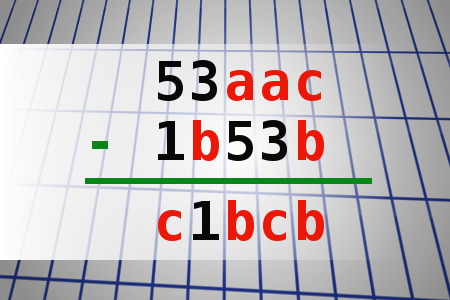
Find number abc
[7006] Find number abc - If 53aac - 1b53b = c1bcb find number abc. Multiple solutions may exist. - #brainteasers #math - Correct Answers: 17 - The first user who solved this task is Nasrin 24 T
BRAIN TEASERS
enter your answer and press button OK

Find number abc

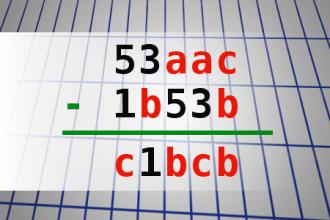
If 53aac - 1b53b = c1bcb find number abc. Multiple solutions may exist.
Correct answers: 17
The first user who solved this task is Nasrin 24 T.
#brainteasers #math
Register with your Google Account and start collecting points.
Check your ranking on list.

Before going to Europe on busi...

Before going to Europe on business, a man drives his Rolls-Royce to a downtown New York City bank and asks for an immediate loan of $5,000. The loan officer, taken aback, requests collateral. "Well then, here are the keys to my Rolls-Royce," the man says. The loan officer promptly has the car driven into the bank's underground parking for safe keeping and gives the man the $5,000. Two weeks later, the man walks through the bank's doors and asks to settle up his loan and get his car back. "That will be $5,000 in principal, and $15.40 in interest," the loan officer says. The man writes out a check and starts to walk away. "Wait, sir," the loan officer says. "You are a millionaire. Why in the world would you need to borrow $5,000?" The man smiles, "Where else could I find a safer place to park my Rolls-Royce in Manhattan for two weeks and pay only $15.40?"
Jokes of the day - Daily updated jokes. New jokes every day.
Follow Brain Teasers on social networks

Brain Teasers

puzzles, riddles, mathematical problems, mastermind, cinemania...

Guncotton patent

In 1846, Christian Frederick Schönbein of Basle, Switzerland, was issued a U.S. Patent for guncotton titled “Improvement in Preparation of Cotton-Wool and Other Substances as Substitutes for Gunpowder”(No. 4874). The process uses a mixture of concentrated acids to convert the cellulose present in well-cleaned cotton-wool, C6H10O5 into cellulose nitrate C6H8(NO2)2O5 (nitrocellulose). In 1891, James Dewar and Frederick Abel incorporated nitrocellulose in a mixture that could be handled more safely. Until WW II, this invention replaced gunpower on the battlefield, where it had been used for five centuries. It was also useful for blasting because it generates about six times the gas of an equal volume of gunpowder and produces less smoke and heat.
This site uses cookies to store information on your computer. Some are essential to help the site properly. Others give us insight into how the site is used and help us to optimize the user experience. See our privacy policy.