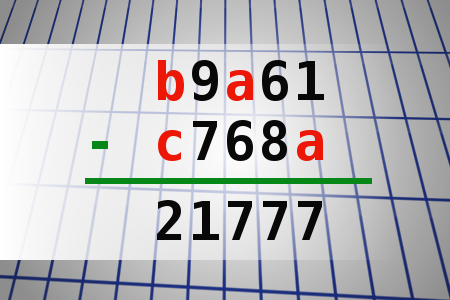
Find number abc
[7234] Find number abc - If b9a61 - c768a = 21777 find number abc. Multiple solutions may exist. - #brainteasers #math - Correct Answers: 7
BRAIN TEASERS
enter your answer and press button OK

Find number abc

If b9a61 - c768a = 21777 find number abc. Multiple solutions may exist.
Correct answers: 7
#brainteasers #math
Register with your Google Account and start collecting points.
Check your ranking on list.

Words of Wisdom...

The problem with the gene pool is that there is no lifeguard.

Experience is something you don't get until just after you need it.

A conscience is what hurts when all your other parts feel so good.

For every action, there is an equal and opposite criticism.

To steal ideas from one person is plagiarism; to steal from many is research.

Two wrongs are only the beginning.

Monday is an awful way to spend 1/7th of your life.

The sooner you fall behind, the more time you'll have to catch up.

A clear conscience is usually the sign of a bad memory.

If you must choose between two evils, pick the one you've never tried before.

Love may be blind, but marriage is a real eye-opener.

Borrow money from pessimists, they don't expect it back.

Half the people you know are below average.

Jokes of the day - Daily updated jokes. New jokes every day.
Follow Brain Teasers on social networks

Brain Teasers

puzzles, riddles, mathematical problems, mastermind, cinemania...

Willard Frank Libby

Born 17 Dec 1908; died 8 Sep 1980 at age 71. American chemist whose technique of carbon-14 (or radiocarbon) dating provided an extremely valuable tool for archaeologists, anthropologists, and earth scientists. For this development he was honoured with the Nobel Prize for Chemistry in 1960. Libby is a specialist in radiochemistry, particularly hot atom chemistry, tracer techniques, and isotope tracer work. He became well-known at Chicago University also for his work with natural tritium, and its use in hydrology and geophysics. On 18 May 1952, he determined that the age of Stonehenge was 1848 BC, based on analysis of radioisotopes in charcoal.
This site uses cookies to store information on your computer. Some are essential to help the site properly. Others give us insight into how the site is used and help us to optimize the user experience. See our privacy policy.